

Wasting Peels

orange peels

I had the boys try candied orange peels last Christmas.

There was a recipe I had wanted to try for years (actual, literal years). I had to track down raw hazelnuts, white pepper, candied lemon and orange peel and candied citron. The result, a tooth-breaking concoction, is a story for another day. In the end, I had quite a large amount of orange, lemon and citron to figure out what to do with, because I will most likely not be trying that again.

I really tried to sell those leftover candied orange peels. I explained how people knew how to make candied fruits before there were knights. How the process to make these is involved, taking days of boiling and boiling again and soaking everything in a thick sugar syrup. How this was a way to preserve sweets before electricity and refrigeration. How back in time nothing was wasted, not even peels. How it used to be when you yourself took the time to plant and harvest, raise and slaughter, grind and bake all your own food.

The boys took one ginger bite each. “This is what people used to have for candy?” My oldest is grimacing, but trying politely to hide it.

“Well, yeah…”

“You know, I feel really bad for people back then, that this is all they had.  Especially if it was so hard to make,” he concludes.

“Mommy?” My youngest is trying to hand his peel back to me. “Do I have to finish this?”

I say what I always say in these cases, “No, honey, you never have to finish dessert.”

It is clear it is going to be up to me alone to eat these; no one else will be helping me do so. I cannot just throw them away, especially after all the weight and importance I put on them.  I’ve started to feel bad for the Medieval children who would have treasured these, those poor souls my own child pities not because they had horribly short life expectancies or lived in disease-ridden poverty.  He pities them for their lack of M & M s and Reese’s Cups. I vow, solemnly, to enjoy them before buying any more treats for myself.

That vow was broken almost immediately, and shamefully, by a McDonald’s apple pie. It was purchased as one of two for a dollar. The other pie was thrown out when I realized eating both secretly in my car would have cost me 500 calories. I tried to give the second one to my youngest in the backseat. He had the good sense to tell me, “I don’t really want any. You know, you don’t ever have to finish dessert, Mommy.”

If any fourteenth century kids ever time-travel and witness this, I am certain that they would shake me by the shoulders, maybe even smack me around a bit, and throw a very sorry, pitying glance at my son for having to live in the world in which he does.
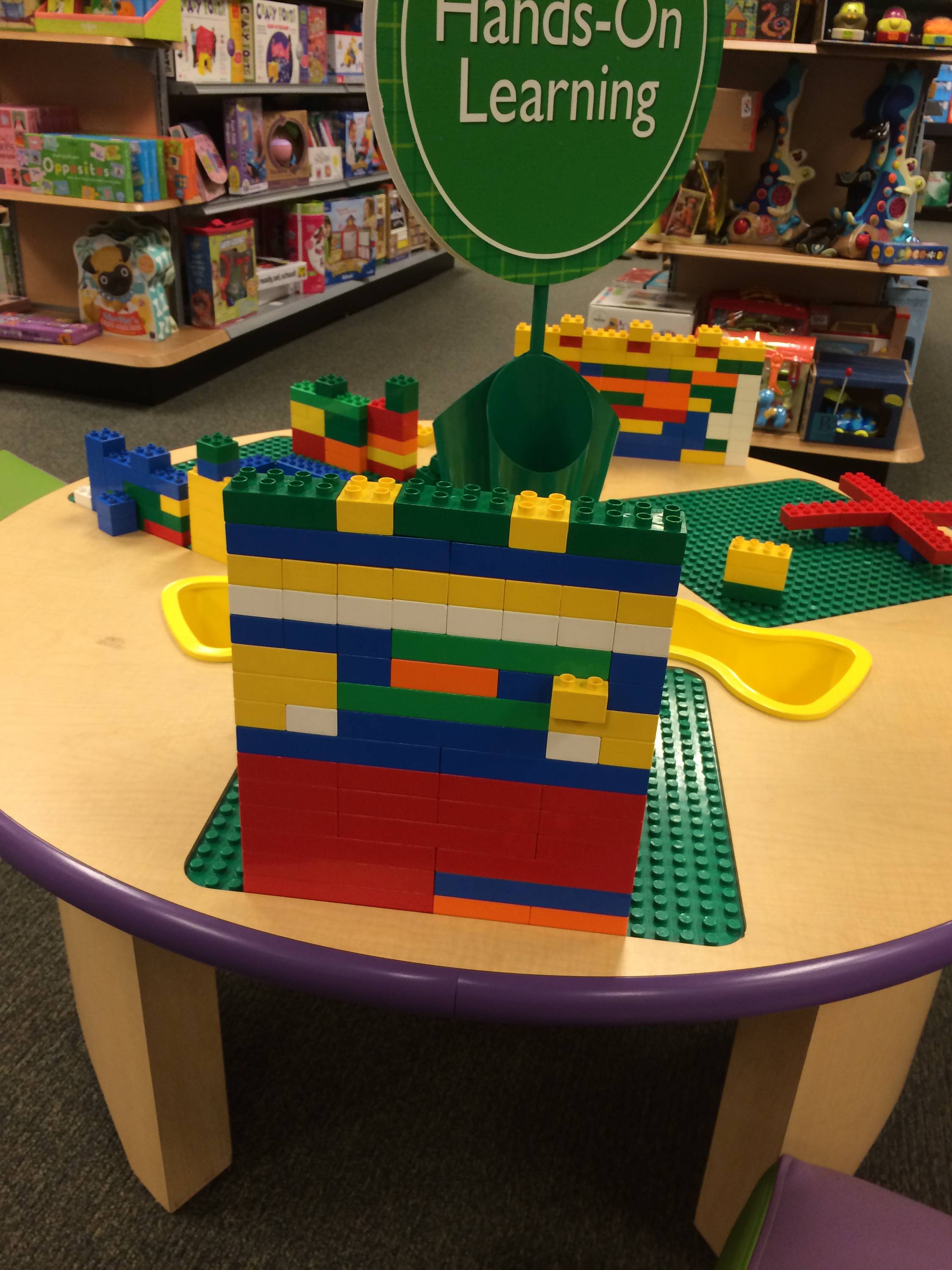
Lego Destruction

Legos

Legos can be…tricky.  Like a blank page and all the words in the English language, a bucket full of pieces seems to offer infinite possibilities for creation.  When you get into constructing your vision you start to see all the problems: how two pieces won’t actually fit, or how it doesn’t look how you imagined it or how it could fall apart at any second.  It can be difficult when it looks easy.

My youngest had been working very hard and very frantically at building a spaceship with Legos. Because he wanted it to be something no one had ever dreamed up before, his older brother and I couldn’t help with its architecture. We couldn’t really point out where a wing could be reinforced or where landing gear could sit without being knocked off the first time it “landed”. He had a vision we couldn’t see yet.

I had been casually calling out to the living room, “Hey buddy, dinner’s almost ready,” while getting out dishes and turning off timers. As I brought one thing after another to the kitchen table, I could glimpse him with the Legos on the couch. I could sense him getting angrier and angrier, and I just assumed he was mad at me for interrupting his game. A little annoyed that he was getting annoyed, I tried one last time to get him to the table to eat. “Hey, come on now, you need to come to the table. I gave you fair warning that it was time.” At that he let out an anguished cry and threw his whole spaceship to the ground. It broke, scattering hard-edged colors in every direction.

“What on earth was that?” This is not a destructive kid. Except for one strange week near his fourth birthday, he has never thrown or broken anything.

He screamed back at me, “I couldn’t get it right!” With his eyes scrunched tight and hot tears coming down, I could see him as an adult throwing a thick manuscript into a fire.  A bitter, worn, angry old man willing to call his work garbage because it wasn’t what he wanted it to be.  Destroying every word, every sentence, every page all at once.

When he looked down at what had really become of his spaceship, he saw that not one part could be salvaged.  The horror of what he had done overwhelmed him.  I’ve never seen him sob so hard.

I held him for a while but I couldn’t really calm him down.  I tried to convince him that maybe using the bathroom, eating, resting would help.  Eventually he sat in his own chair in the kitchen, quiet. Even more quietly, he slid out of his chair and into the living room.  He sat on the rug and for the next twenty minutes he rebuilt his spaceship. When he was done he came back to the table and ate his now-cold dinner without a word.  His older brother and I ate silently, watching it unfold.

I’ve heard experts say please, please let your children fail when they are still children. Let them lose a game, mess up a friendship, fall off the playground without intervening so much.  Their lives are going to be filled with problems and they need practice solving them when the stakes aren’t so high. Let them work through difficulty instead of rescuing them. This time, even if I had wanted to, I couldn’t rescue him from his creative frustration and I certainly wasn’t able to comfort him. I got to watch him decide what to do about that demon that told him his creation wasn’t good enough, wasn’t right. He wept over the aftermath of destroying it. He decided on his own that it was imperative to try again.

At bedtime, I told him I was proud of him. One day it might be an entire manuscript that he wants to hurl violently away.  And maybe some memory of this, quiet and still, will make him pause before he can do it.

Watermelon Mush

watermelon

When I was a new mother and had a six-month-old who had begun trying solid foods, some overly concerned women who worked with my husband exclaimed, “She’s home all day and doesn’t make her own baby food?” He relayed that conversation to me with a shrug and support, “You know I don’t care if you make baby food right?” Then he handed me the baby-food cookbooks these women passed to him, to pass on to me and I stared up at him hard. My heart sank so far down. Here was another way I was failing as a mother, how I was wasting hours and giving my baby less than he deserved. Not to my husband, thankfully. Again he said, “I really don’t care one way or the other. They mean well. I brought them home only to shut them up and…well you did like to cook, before.”

I did like to cook before, before I had post-partum depression, before I felt cocooned from the world. The only news from the outside came from women who were preoccupied with how my baby was bottle-fed or how I couldn’t keep my child from mouthing cart handles or how I didn’t steam and puree organic fruits and veggies. But, cooking had always been a way for me to enjoyably fill the hours; sharing a meal with someone I loved made me happy. Maybe I would ignore the books (especially the one which advocated for brewer’s yeast as a snack) and pick some foods that my baby couldn’t get it a jar. I would cook for him.

Pureeing watermelon was an all day project, or else sleep deprivation just made it seem that way. Hacking away the rind, mopping up the pink juices before the ants could find it on the kitchen floor, digging out the food processor and figuring out how to get it put together took too long. Maybe it was the prospect of keeping my baby safely away from sharp objects while entertaining him that may it seem intermitable. Eventually I had a small mound of fuchsia mush I felt somewhat proud of.

My baby took one bite, shot a look up at me that said, “What the hell is this?” and refused to open his mouth again. As I think back now I’m sure the coarse texture paired with an unusually sweet juice startled him and felt wrong. Or perhaps he just knew that this is never what was meant for this poor melon-a spoonful made of loneliness and self-consciousness. I stared at him for a moment before getting up slowly and retrieving Gerber sweet potatoes, which he devoured happily.

I felt just hopeless, because this had failed, because I couldn’t prove to anyone that I was a worthy stay-at-home mother, because I hadn’t saved any watermelon in large juicy crunchy pink triangles for myself. All I had was this slushy, lukewarm pile that not one of us was going to touch. Down the garbage disposal it went.

Today he is seven and a half and just ate about half a watermelon with dinner. I feel vindicated that I hadn’t ruined him for good food. And, I feel extremely angry that I had let some random woman make me feel that I had, that I was not doing enough, that I wasn’t enough because I bought a few, tiny, glass jars once upon a time.