Maybe the ability to stay joyful is the only thing to make the end of the world not feel like the end of the world
Kids
Since becoming a mother (with a teaching degree in my background) I am thinking constantly about kids. Their unique viewpoints, their education, their quirks, their questions fascinate me.
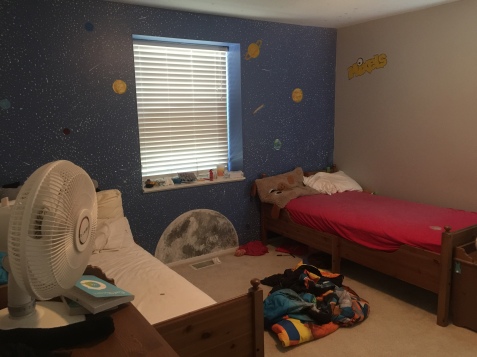
Image Description: A child’s bedroom with two beds and one wall that is mostly blue with paintings of planets, stars and a close-up of the moon on it.
Hi everyone!
Today I have an essay up at The Manifest-Station called Bedtime (you can click on the title to link to the essay).
This is a story of two bedtimes, one recent and one more than six years ago. Part of the story is about the painful limitations I encountered being a parent with chronic illnesses. Part of the story is about how miraculous getting to be a parent at all feels.
This is a chapter in the book I am working on called Quote/Unquote “Healthy”. I announced here last summer that I hoped to have it done before the 2017-2018 school year. Well, illness gets in the way sometimes (and adds more chapters I need to write about!) but I hope to have the full manuscript done by November.
The Manifest-Station has given this story a wonderful home, and a gorgeous accompanying picture that is beautiful…and makes me smile as it doesn’t look much like the room this actually took place in. So, for you all I included the real thing, for authenticity’s sake.
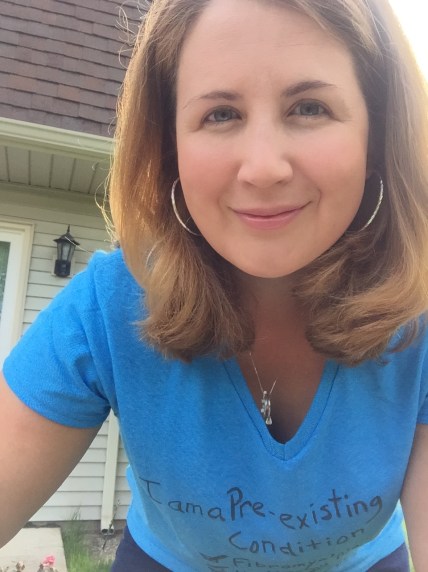
Image Description: me looking at the camera, my long hair down, wearing my hand-made, blue “I am a pre-existing condition” t-shirt
Hello everyone,
This weekend is an interesting (but not bad at all) one for me.
In the midst of celebrating Mother’s Day, I am attending a Die-In to protest the AHCA at a local representative’s office (Not mine, my representative is an outstanding advocate for us-the representative for the neighboring suburbs is not).
I announced I would probably leave the house by 10:15 am to which my kids asked, “Where are you going?”
Without looking up from his phone my husband deadpanned, “To die.”
Luckily my kids are, by the ages of eight and ten, used to being teased by my husband and always ask me, “No really, what’s going on?”
I briefly explained that a lot of people voted against my ability to have affordable health care in the future, that people will die without treatment and so we were symbolically going to pretend to be dead for a few minutes in front of a congressman’s office, to demonstrate what he voted for.
Along those lines, and in a less brief format, today also I have an essay up. It details a little bit of my struggles with chronic illness, my reaction to the recent vote and what it will mean for my family if it becomes law.
So, in a little bit I’m off to pretend to be a corpse. Then I’m going to visit with my parents and my kids in a park filled with lilac bushes, give my mom her customized #Iamapreexistingcondition t-shirt (I haven’t made my mom something with markers in a looooong time, I felt like a kid again) and enjoy both having a wonderful mother and being a mom to some pretty awesome kids.
Who are probably going to play Minecraft while I lie in a ditch somewhere.
Take care!
Kristin
Image Description: A t-shirt that says “I am a pre-existing condition” with a list of my illnesses, fibromyalgia, Hashimoto’s Thyroiditis, hypoglycemia, dermatographism, 2 C-sections, post-partum depression and food sensitivities
Image description: the back of the same blue t-shirt with the words “My life has value”
Image Description: a pink t-shirt with the words “I am a pre-existing condition” and a list of my mother’s illnesses, Parkinson’s Disease, hemochromatosis, Mitral Valve Prolapse, and C-section
The following essay first appeared on the website, Progressives of Kane County. Hence the somewhat longer introduction to who I am…
I want to briefly introduce myself. My name is Kristin Wagner. I was born and raised in the Chicago suburbs, and after living in Tennessee and Texas returned back home to raise my two boys. I am a wife and mother, a former high school English teacher and currently a writer. I volunteer at our school and take my kids to the pool in the summer and sit outside of piano lessons making up grocery lists.
I am also a chronically ill person. Though I am somewhat shy about using the term, I do identify as disabled. I have Hashimoto’s Thyroidistis, fibromyalgia, chronic urticaria with dermatographism, a dairy sensitivity, hypoglycemia, allergies, premature ovarian failure, and sometimes depression. I walk a tightrope each day to manage the symptoms of each illness without causing more problems with another illness.
The process of getting to a place, a decade after I began being actively sick, to where I can get by involved neurologists, gastroenterologists, endocrinologists, rheumatologists, allergists, gynecologists. It involved trips to the ER with unexplained pain, ultrasounds, x-rays, an MRI, an EEG, an EKG, a colonoscopy, steroid shots, and blood tests measuring almost anything that can be measured in a blood sample.
I am forever grateful that when I had horrible symptoms that could have pointed to cancer (ovarian and colon) that my doctors never hesitated for a moment to check. Those scans were negative. That when my blood sugar kept dropping for no known reason, my doctors tested me for diabetes and insulin-producing tumors. Those tests were negative. That when I couldn’t feel temperature we immediately checked for Multiple Sclerosis. Again negative. When I had such bad chest pain that my doctor thought I may have been having a heart attack, I was able to get myself checked out without worry that I couldn’t afford it.
I have been lucky. I have been in huge amounts of pain, but I am lucky. The entire time I have been ill we have had insurance. I have been afraid of what my illnesses have cost us in co-pays and premiums and prescriptions, but I have never gone without care. I have never had to ignore a pain that could be cancer or a degenerative disease because I couldn’t go to a doctor. I have never had to go without medicine I need because it was prohibitively expensive. I have been able to track down what is really going on when I feel too sick to move. And because I have been able to take care of my health, I can live my life as well as I am able knowing I will never really be “healthy”.
Thursday, May 4th 2017, the day that the majority of the Republican members of the House of Representatives voted for the AHCA, was devastating. All I could do was stare at my phone as the votes rolled in, stunned into silence that people who should be my voice, who should care about my life, were so happily cutting it in half. I cried because for the very first time in my life I was looking into the faces of men who rejoiced in the idea of me dying. I suppose I’m lucky it took me so long in life before I had that feeling wash over me. That day 217 members of my government decided that my life, my happiness, my ability to be as good of a mother and person as I could be, was too expensive. That my life wasn’t worth the money it takes to keep me going.
They voted to eliminate protections for people with pre-existing conditions. If my husband lost his job and we couldn’t afford insurance for a little over two months, every single illness I have on record might be used against us as excuses to raise our premiums to exorbitant levels, effectively pricing us out of insurance. The birth of my two sons, by C-section each time, might even be used against us. My illnesses and necessary surgeries could conceivably bankrupt us.
They voted to add annual and lifetime caps on coverage, which were both banned by the ACA. At thirty-eight, I very well may have used up what I was “allowed” to use up, potentially leaving me without continuing care for the illnesses I already have and any without any ability to deal with other diseases. Most likely more will come up. Having one autoimmune disease (for me, Hashimoto’s Thyroiditis) often means others come along (like Premature Ovarian Failure) and more might pop up later (like Rheumatoid Arthritis, or Lupus). People will die from lack of care, from lack of preventative measures, from lack of diagnostic tests.
I am not being hyperbolic. The 217 Members of Congress who voted for the AHCA voted to kill constituents, to shorten their lives, because keeping people alive and healthy is expensive. There are definitely people in the world who subscribe to the idea of eugenics, who have no problem letting disabled and ill people die because they, according to this horrific philosophy, don’t contribute economically as much as totally healthy citizens do. May 4th the Republican Party voted, gleefully, to cull the sick and the poor out of our country for the financial gain of the already wealthy and the insurance companies.
If this unconscionable bill passes the Senate, I do not know what I will do to try to stay physically healthy. I will most likely try to get by on the bare minimum of care, so that I don’t exceed my annual or lifetime caps, assuming that if I am going to live as long as I can more diseases will find me. My quality of life will be diminished as I spend more time in pain or exhaustion than I needed to, because treatment that exists will no longer be accessible. We will be abundantly cautious with our money, taking no risks. We’ll have my husband stay with his progressive company, saving as much as we can to forestall an inevitable bankruptcy. Maybe I will hide what I’ve been through, leaving no paper trail to suggest I am less healthy than I appear on the outside. And yet, I am comparatively lucky. We still have money to save, my husband still has a job at a good company, the illnesses I already have are (for the most part) not degenerative. There are people who will make it only a few years, a few months, a few days, without continuous care.
Even if this bill dies as soon as it passes through the Senate doors, I do know what I will do to stay more psychologically healthy. I will do whatever my sick body will let me do to rid our government of every single Representative who, by voting yes on the AHCA that day, demonstrated the lack of human decency we associate with unmitigated, unredeemable monsters.
I’m lucky I still have a voice to help me do just that.
We are Americans. We should be taking care of each other, our sick, our poor, all of our people. We have the capability to do just that. A government’s job is to take care of the people under its care, to protect them from enemies within and without. We should protect all of our citizens, and when it comes to military spending we seem to think no cost is too high, no weapon too expensive. And yet… an estimated 43,000 Americans will die prematurely annually without access to affordable healthcare, the casualties equivalent to having a terrorist attack of the scale of 9/11 every single month.
Those 43,000 lives have worth. My life has worth. I am ill, I am disabled, and I am worth keeping alive.
Even if our Republican representatives do not think so.
My favorite reading experience, where the book I was reading matched the circumstances around me perfectly, used to be easy to pick out. I often used to take the train from the Chicago suburbs to Champaign-Urbana, when I bounced back and forth between my parents’ house and college. This particular trip I took was in the evening in the middle of a cold, clear winter. While the train was usually full enough that I was obliged to make small talk with a seatmate, this time it was almost completely empty and silent. Every other time I sat under fluorescent lights with dull grey metal all around me. This time I found myself in a refurbished Pullman car. Red velvet lined the seats, with a fringed gold trim edging the armrest. A sumptuous carpet rested under my feet. The lights had a soft glow emanating from ornate sconces. I burrowed myself into my seat, cushioned and alone, and picked up where I had left off reading The Shining for the very first time. The opulence matched The Overlook Hotel, and as I glanced out the window at an endless stretching snowy winter, seeing a single farmhouse light in the distance echoed my own isolation and that of the Torrences. For nearly twenty years that has been my favorite.
I may have a new contender. I have been sick with a really horrible protracted cold, and my boys are now sick with the same excruciatingly slow virus. My husband is traveling for work, and the boys have now missed three days of school. Last night my oldest wanted to sleep on the couch, so when he went to bed I tiptoed to my room and grabbed a book since I was not going to be able to fall asleep at 8:30. I had bought Room by Emma Donoghue more than a year ago and hadn’t touched it since. I’m not sure if I was worried that my heart wouldn’t be able to take it, but for some reason it nearly jumped off the shelf at me this time.
We are told the story through the perspective of a five-year-old boy named Jack. He and his mother are held captive in a small room by the man who kidnapped his mother years ago. The book opens on his fifth birthday and describes how they manage to make a life for themselves in “Room”, a place Jack has never left. It opens on the day of the spring equinox. I began to feel eerie, as yesterday was the spring equinox as well. Jack describes what TV shows he likes to watch, and because this is set in contemporary times, they are all shows my children watched too. Backyardigans, Wonder Pets, Dora the Explorer. The way his mother helps structure their days reminded me so much of what it was like when the boys were small, when one day can bleed into the next if it is just you together in the house, seeing no one else, going nowhere else. A state I am in right now. It is just us, quarantined away from the world, only using the resources we have on hand, and with each other as our sole company. It is both intimate and confining all at once.
Jack counts his teeth with his tongue when he is trying to distract himself. Each time he does I do the same and am reminded that a crown popped off one of my teeth earlier in the day. As I think about when I’ll be able to get that fixed Ma takes a ‘killer’ (painkiller) because her bad tooth is aching very badly. She is also waiting to get her tooth fixed, though for her it may never happen.
I read more than half the book in that one sitting, entranced, both seeing myself and the day I just had and the day I was about to have stretched before me, and seeing how much more I had that they didn’t. A window. A telephone. Food in the cupboards. The ability to open the door and feel fresh air on my face. Things I would never have stopped to appreciate that I still have even if I don’t have the Outside right now.
I’m not capturing how odd it felt, how odd it feels when your reality and fiction blends so perfectly together that you cannot extract one from the other. It isn’t something you can plan, though luckily sometimes it comes together. I read a scene from The Signature of All Things where the protagonist laments how useless paper is on a tropical island exactly one day before discovering all our paper was a humid mess in Puerto Rico. We read Harry Potter for the first time through the 2016 election and the coincidences were spooky (though that is an essay for another time). I guess I’ll tell this story better after twenty years than I do now, but I wanted to say…
Books are magic in a totally unpredictable and unusual way. And in the middle of a boring household cold, I got to experience that again.
Today is International Women’s Day. This particular March 8th is also, in the United States, Day Without a Woman – a general strike to highlight the importance of women and how their contributions of both paid and unpaid labor are grossly underappreciated. I have been spending all of this week leading up to today trying to figure out how best to honor both.
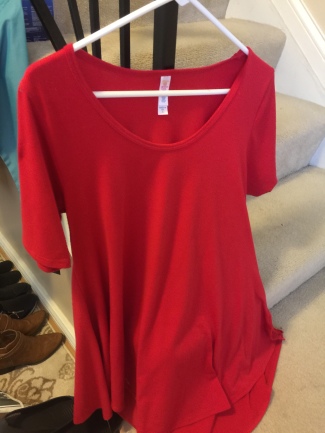
The easiest way to support the day and the strike is to wear red, a show of solidarity with women fighting for equal rights, opportunities and recognition. Done. I’m wearing red, my two kids are wearing red. Easy.
The next is slightly harder. As women purchase 70-80 percent of items and services for sale, women are asked to refrain from purchasing anything today, to demonstrate how much our purchasing power is worth. Another way to do that is to purchase exclusively from women-owned companies. I will be purchasing an item to support the wonderful online site The Establishment, a bastion of intersectional feminism and support for writers (they pay every writer for every story they publish-which is unusual and welcome in the world of online publishing). I won’t be buying lunch, or dinner, or groceries, or clothes, or books, or my kids’ haircuts or an oil change for the car today.
The last is the most difficult. Women are called upon to strike from all paid and unpaid labor today. Except for the once-a-month tutoring gig I do get paid for, all my labor is unpaid right now. I am a published writer who last got paid for an essay in 2007, and a stay-at-home mom. When my husband is not traveling for work, we already share household chores and child-raising tasks equitably. He doesn’t need a reminder of what I do, and I feel appreciated. And if I refrain from writing, I lose the opportunity to advocate for recognition of the work that women do. So I won’t be taking time away from unpaid labor.
I also never thought of it this way before, but I have women in my employ. I am a chronically ill person who functions most weeks as a single mother would, taking care of everything while my husband travels for work. We have a service come and clean our house every two weeks to help. Vacuuming, washing floors, dusting high shelves, scrubbing toilets: I can technically still do all these things. However, the pain and energy cost of doing these chores (my fibromyalgia tends to flare) leaves me bankrupt for days sometimes, unable to do other things that need doing. I am so grateful to have the three women who do this work for me. Wednesdays happen to be the days they come. I appreciate what they provide for me so much, and know I am a more productive person if I let this work still happen. If they do strike today, I am completely supportive and understanding. If they do not, I will try to make sure to tell them how much I appreciate the work they do.
But, most of all, what I want to do today is explain just how many women make my world possible. I have lived in the world of women for a decade, a world of stay-at-home moms, retail workers, grade school teachers, pediatricians, nurses and volunteers.
I will start with school. From the early intervention services that my youngest had at age two, to the fourth-grade teacher my oldest has now, almost every single educator my kids have had have been women. Since preschool my oldest has been taught by at least thirty teachers and four teacher’s aides, and only three of them have been men. Since early intervention my youngest has had four speech therapists, and at least twenty-four teachers and teacher’s aides, I think one of whom has been a man. We have a male principal, but the vast majority of workers at the school, from the school secretaries to the lunch moms to the volunteers who organize fundraisers and room parties, are women. Grade school workers are notoriously underpaid and in a capitalist society being underpaid means being underappreciated. I love our school.
I went to work out today. Seven out of the nine receptionists I see regularly are women. When I peek in on classes, I have yet to see a male instructor. Most of the trainers are women. All of the instructors for early childhood classes at my park district are women.
I thought about spending time at our library. I have seen two male librarians over the course of nine years.
Where we get our boys hair cut, eight out of the nine hairdressers I see regularly are women.
Grocery stores, at least half the employees are women. Fast food and slower paced restaurants seem to be the same, at about 50%. So is our local post office.
Clothing and shoe stores? Almost 100% women.
Our local food pantry and community services administrators? 80% women.
Emergency room at our local hospital? The boys and I have only ever seen two male nurse versus about twenty female nurses. We’ve seen two male doctors versus at least ten female doctors.
The pediatrician’s office? All the nurses are women. Half the doctors are as well.
We would visit my mother when she worked at the offices for our local church. A full half of the support staff the offices, and roughly 90 percent of the teachers for both year-round parochial school and CCD were women. And these are just the paid positions. Mothers often volunteer to help even more. In fact that’s how my mother got her foot in the door for this job in the first place.
Most of the women I know, whether they work outside the home or not, do vast amounts of unpaid and unappreciated labor. I once had a conversation with other moms who were completely shocked that my husband did the grocery shopping for our household. I was told that to expect their husbands to do this task was completely unthinkable. Working women still do more household and child-rearing chores then working men. Stay-at-home mothers are still looked down on as if they aren’t contributing.
Most caregivers for disabled people and the elderly are women, both paid professionals and unpaid family members.
On top of all this, is the emotional labor that I have seen women do for free. The labor of keeping relationships healthy, families emotionally whole, communities functioning and working together.
The contributions women make to this country, to the world, are staggering.
The last other thing I am going to try to do today is to spend time not only thinking about how much would be lost without women doing the too-often invisible work of the world, but how much would be lost without their voices too. I have set my playlist to all the music I own either written or sung by women. I am reading I Am Malala for the first time.
A really good friend of mine once told me, totally unaware that I was then a hormonally insecure mess of a mom-of-small-children, that she always thought I would do really well with my kids when they we like ten. At the time I took it to mean that I must be hopeless with babies (I kind of am) and threenagers (I do tend to lose my mind), not that I would really hit my stride once my kids got to be tweens. It is a compliment that has taken me years to accept both in its truth and its sweetness. I am really good with kids approaching ten.
It could be that I’m just good with my kids, one of whom is approaching ten and the other who is seven. We’ve have had people ask us what we do with the boys – they are pretty well-behaved, empathetic and that all-important measure (insert big eye roll here) they standardized test really well. I don’t have a great answer that is easy to bust out over small talk, because the real answer is that we have a lot of stoner conversations. Without anyone being actually stoned, of course.
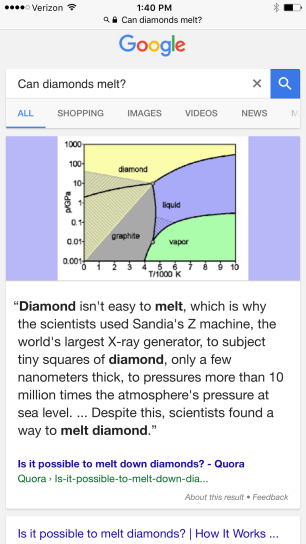
Once your kids are verbal and start asking questions, you need to answer them and start asking questions of your own.Whatever musings pop up, man we take our time exploring them regardless of what else needs to happen. We’ve talked over whether a diamond could melt in a volcano and what that might look like. We’ve gone over The Garden of Eden a few times; “So God can make a talking snake that tries to tempt people to be bad, but he can’t let Adam and Eve get away with breaking a rule he himself made? Is God all-powerful or not?” I get questions like, “Can I try to catch fish with a mosquito net?” and “What if I made a tiny computer for my stuffed animals?” and “Do you think Voldemort is milking a snake and drinking it’s venom to make himself into a snake?” The other day we had a lengthy discussion about whether or not one of our hands was fatter than the other and why that might be.
My oldest asked, “What if people made up the idea of souls and heaven and hell to get people to do what they say?” My youngest asserted that if someone was doing nothing they were still doing something. Damn, it’s fun.
We are thinking critically non-stop around here. When you take a stoner conversation seriously, no matter how goofy the topic may be, if you tease it out and give it time and attention and try to figure out whether mosquitos could bite God if God is invisible, you find stuff out. You learn facts,
You learn how to argue, you learn how to imagine, you learn that creativity and questions are wonderful things, you learn how to dig deep, you learn how to analyze. You learn that there are mysteries. You learn that wondering is fun. Curiosity is a gateway to deep learning.
And ambiguity is a gateway to open-mindedness. You learn the complex idea that maybe there is no right answer. Sitting in the ambiguity that comes after the question, “Why did people think people had souls to begin with, who came up with that idea in the first place?”; uncertainty unsettles kids in a great way-my guys never assume, even though they are quite smart, that they have all the answers or that the way they see the world is the only right way. These conversations make them open to new ideas and new experiences and new people.
So, if your kid asks if you think that aliens might have other senses that we don’t even know about some morning as they are scooping up Frosted Flakes and you are trying your damnedest to pack a lunch and shove a signed permission slip into their backpack, know that the best thing you might do for them in that moment is to say, “Like, are we talking aliens who live underwater, or ones that are humanoid, or like giant blobs who don’t even need to eat? Because if we are talking humanoid creatures what sort of sense could they have we don’t? If we’re talking blobs, man, who knows what they would be able to do, that’s a whole other ballgame.” It seems to be working out well for us.
While I love mountains, with their massive size and impressive countenance and sheer arrogance, I usually do better admiring them from afar. I have a fear of heights and the thin air seems to make me feel unwell – my breathing is labored and since my breathing mimics a panic attack, my brain seems to think I should be feeling far more anxious than I am and begins to really get nervous. Most times I have tried to enjoy mountains I have gone from almost sea level to a peak in less than a day, I’ve been assured by guidebooks if I had only let myself get acclimated longer I would have been just fine. We never reached the accessible peak in El Yunque in Puerto Rico because I got nervous and couldn’t breathe and so got more nervous and pictured my then five-year-old son falling over the edge of a cliff and I made us turn around. In Alaska this last summer we went from the coastal city of Anchorage to Polychrome Pass in Denali National Park (at 4,000 feet in elevation) in the span of twenty-four hours and I was suffering. It didn’t help that I had also picked up the stomach flu from one of the boys who had picked it up on the airplane ride in, but that is a different story. The mountains are beautiful and so vast that I finally realized that there are places on earth we won’t ever be able to truly destroy-we would kill ourselves off first before we could uproot Denali-and that is comforting. I now really understand the feeling of being built upon rock instead of sand, solid and unmovable. But the mountains aren’t mine, not the way the sea is.
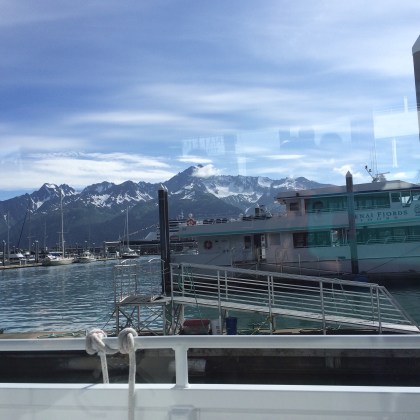
Seward, Alaska is about a two and a half hour drive south of Anchorage. You leave town by Highway 1 (there are really only a few highways connecting all of Alaska) which winds for about an hour around a massive ocean inlet called the Turnagain Arm (named so because explorers looking for a Northwest Passage thought they had it found it but became landlocked and had to regretfully turn again). Two lanes cut between the Chugach Mountains and the ocean, leaving little room to not feel claustrophobic or nervous. Well, for me, my husband seemed unphased driving past harrowing cliffs. Once you leave the immense Turnagain Arm behind, you wind through more mountains and past yellow diamond signs that warn of avalanches in the winter. It is not winter and I am grateful for once that the Chicago suburbs are flat and home to a million plows and salt trucks. Finally it doesn’t seem as if the mountains will ever end when you come upon the sea, abruptly enough you can imagine driving off of a pier because you glanced in the rearview mirror at the wrong time. You have arrived at a port town, a hub for cruise ships and fishing fleets, an access point to fjords and glaciers and water that is clean and cold and a strange crystal green.
Here is where we needed to come to see the other half of “things we may never again see in real life”. Denali gave us mountains, and gold rush cabins, grizzly bears and caribou. Seward will give us whales, bald eagles, puffins, glaciers. I have prepared. We have sea-sickness bands, all of us. We have leggings and winter coats and hats and gloves (things that took up a whole other suitcase, things we will only need here). We are set to board a tour boat with catamarans (which I am told help to prevent seasickness). There is an outside deck, and an inside cabin with huge windows where, when we get cold and tired, we can rest and sip hot chocolate or tea and just be taken to beautiful places. This is more exciting to me.
My childhood was spent on boats, every summer until I was twelve. Each Saturday we would drive an hour or so north to the Chain-Of-Lakes. We had speedboats, the first one I was on as a toddler I am told looked like the Batmobile. There was Big Red, then a white and teal boat that I know traveled to Missouri with us one family reunion, and finally the Over-Ripe Banana Boat which was banana yellow with inexplicable brown glittered panels. Admittedly the names for the boats were my own, but maybe I shared them with my family at the time. My mom would pack a cooler and eventually four children up in our mini-van, my dad would drive us to the slip then steer the boat all day. The three of us who took after the Italian side in looks would be slathered in SPF 8 before getting strapped into life jackets, my Irish red-headed brother got SPF 50.
The two things that made me happiest on the boat was when we would be going fast enough to feel wind pushing back our hair and to get to stare endlessly at the sparkles on the water as sunlight hit the tiny peaks of waves. I could spend hours just experiencing those two things.
My husband had declared early on in planning this trip that we needed to find a whale-watching tour, and that we would go as far as necessary to find a tour that could all but guarantee we would. Nobody, on their website, would be so foolish as to promise that you would get to see orcas and humpback whales, but I had read enough reviews that I felt fairly certain we would. I secretly would have still been overjoyed to be on the water without spotting any aquatic life, but I knew he wouldn’t have. I held my breath, just a little, for his sake.
I needn’t have worried.
Within the first half hour we spotted a pod of orcas, a family that the fisherman and tour guides knew quite well as they like to visit the boat and steal fish off of lines. The patriarch of this group had a six-foot tall dorsal fin, and researchers had given him the name “El Dorado”. He led his family, calf in tow, not more than forty feet from the bow of the boat. We were all on the deck watching as their heads would peek up in a friendly gesture and then they would disappear and reappear either further or closer than you would have thought. It was disconcerting to not be able to predict where they would be, most of their journey beneath the waves unseen and their speed and depth and maneuvers all a mystery. They stayed with us for a good long while and we stayed with them until the captain felt we had had our fill and knew we had more to see.
Over the next six hours, we would sometimes skim the water at about 26 knots (I know because they had TVs with our coordinates and speed all throughout the cabin) fast enough that the wind would whip your hat off your head, but not so fast that you were automatically forced inside. Then we would loll in the ocean, trying not to frighten away immense sea otters floating on their backs in the middle of nowhere, or sneaking up on a pod of humpback whales. One adolescent whale (apparently the size of the creature made its age obvious to the captain when it wasn’t obvious to the rest of us) was showing off, leaping out of the water again and again, slapping his fins, doing the backstroke. We glided past the perches of sea lions and bald eagles, and I got to see my husband and kids rapt with attention the entire time. We got to find out that puffins flap their wings like they are graceless heavy hummingbirds when they try to take off. And we felt nothing but affection for their goofiness.
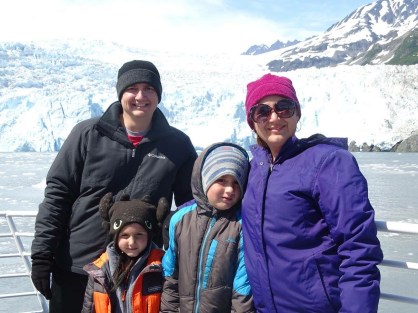
Told we would be going to the glacier next, I brought my youngest into the cabin to get extra layers put on, while my husband stayed at the bow of the boat, camera around his neck, sharing a moment with my oldest. Once we got to the glacier, where balls of ice snapped, crackled and popped in the water below us, their teeth were chattering. The crew used a net to fish one crystal ball out of the ocean for us to hold as we stared at this massive formation, thundering as its blue sides calved. We had been wearing short sleeves on shore, and now we were wearing leggings and winter jackets, hats and gloves. This was the last big thing on the itinerary for this tour, a culmination of ALASKA, writ large. The photo-op to show us later that we had been in this magical place, that we had seen these magical creatures. We had gotten to visit them, stopped by for a chat, enjoyed their home instead of forcing them to perform for our amusement in ours. We got to gaze up at a sheer wall of ice that had been crumbling and advancing for thousands of years without really diminishing. This was it.
The ride back was supposed to be the denouement. The bobbing rest of being brought back to shore again, complete with just-baked chocolate chip cookies and the opportunity to purchase a booklet of pictures taken near the Kenai Fjords we had just seen. I wasn’t ready to be done, though, and while most of the passengers and my own little family stayed inside I went back out to the bow.
This, the sea, this is mine.
Now was the time, though everyone on board had been friendly, gracious and excited as we were, I was finally free from having other people in my sightline. I could pretend that I was alone flying above the icy water. Away from the glacier, now, I took off my hat and let the wind whip through my hair, twisting and knotting and tangling it up however it liked. All around me was the sparkle of blue-green water, nearly three hundred and sixty degrees of dazzling expansiveness. The enormous rock formations loomed as we passed them, I filled my lungs over and over with beauty and speed and freedom. When I thought I had had enough I began to go back towards the cabin, but would stop and stay longer. Once forty-five minutes passed I felt guilt at wanting to pretend I was alone so long, and came back to see how my children and husband were faring. One of my children though wanted to go back with me, and I was overjoyed. I helped guide him bracing my feet against the rock and sway feeling more securely grounded than I had in a long time.
I wordlessly shared my beauty with him holding his shoulders and smiling. When he had breathed deeply enough, I consented to going back to rejoin the no less beautiful world of my family again. Then my other son wanted to have a moment with me on the bow, too, and I happily went back one last time. With him, I finally saw that we were really approaching shore, that this would be closing. It had to, and I finally felt ready to let it conclude. I hadn’t been ready to let it go before I really needed to, but now felt steady knowing I had received enough to sustain me for a long time after.
This is mine, this was something given to me that cannot be taken away.
And they didn’t even advertise this as part of the tour. They didn’t know how much I needed that.
I have a short essay up at Literary Mama today, a reader response to the question, “How does children’s literature influence your parenting?” My response was Roald Dahl, Candies and Tyrants, a quick essay on what my two boys’ favorite parts of the Roald Dahl canon are, and why.
My posting on the blog has been a bit dodgy this summer (dodgy, huh, I must be reading too much Harry Potter with the boys). Sometimes, in the past, less-than-consistent posting has meant good things are happening (feeling healthy, vacation, etc.) and sometimes that has meant bad things are happening (you know, feeling sick and such). This time around it has meant something different, something I have never attempted before.
I am working on writing an entire book, and it scares the bejeezus out of me.
80,000 words is a fairly standard length for a collections of essays or memoir. My goal is to get at least those 80,000 words into a first draft by next summer. I began about a month ago. So, three hundred words at a time I have plugging along with occasional super productive days of 600 words. This gives me weekends off and is achievable even on bad health days (like earlier in this week I had written about 500 in the morning and spent the afternoon in the ER with shortness of breath). Which is really important considering…
It is going to be a collection of essays around what it is like to be one of those people who floats on the edge of healthy and sick all the time. It will have episodes that illustrate what the depths of brain fog feel like, what being in pain does to your ability to parent, how hard it is to get dairy-free food in Wisconsin. Some chapters (like that last one) are sillier than others. It alternates between the hard and the easy, just like my life does. The tough ones take it out of me as I relive times when I felt overwhelmed and uncertain and scared. And as anyone who ever did theater knows, making someone laugh can be harder than making someone cry, so the goofier chapters aren’t a walk in the park either. It is kind of more exhausting than I had anticipated! At any rate, it certainly wouldn’t do to sacrifice the healthy days I have overextending myself writing too much at once. That would be quite self-destructive.
There is also the emotional tightrope I’ve been walking daily between anxiety and audacity, humility enough to say, “This isn’t working” and the confidence enough to say, “Now this is working!” Not going to lie, it is messing with my head. It is simultaneously as terrifying as jumping out of an airplane and as boring as a 1.2 on a treadmill facing a brick wall. I am beat tired.
So there have been fewer other posts. I have some in the works – I want to write about our glacier tour in Alaska, about the beginning of the school year, about a Little House on the Prairie Cookbook – but it is going to be slow going.
Thank you for your patience and understanding!
Now if you’ll excuse me, I am off to calculate how many words I have written so far against my goal total…
These were bears we saw from a bus, several hundred yards away. When you know you’re protected, they’re a lot cuter. Awww.
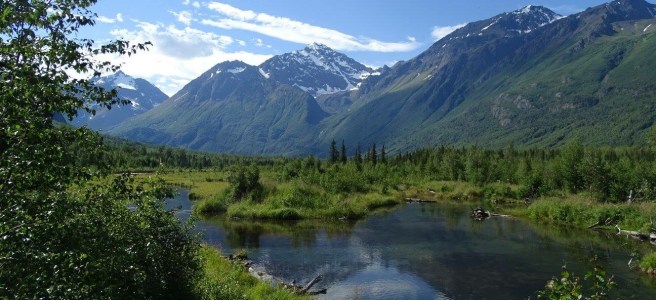
The first Saturday morning of our family vacation found the four of us at the Albert Loop trailhead near the Eagle River Nature Center of Chugach State Park, Alaska. This was supposed to be an easy, well-kept, three mile loop that would take us past crystal clear streams to a spectacular view of a mountain valley. We assured our nine and seven-year-old that they would be able to handle the hike by showing them through phone apps how far we had hiked other days: one and a quarter miles around University Lake next to our hotel, one and a half miles on the Tony Knowles Coastal Trail in Anchorage. Just wandering around the fourth of July fair was probably a couple of miles when it was all said and done. We all felt pretty confident.
We showed up about an hour before the nature center actually opened and read the notices pinned to the door to get oriented. There were bears nearby, and what we needed to do was to stay together and stay loud. You never want to surprise a bear, but he will steer clear of you if you are noisy and generally annoying. If a bear approaches you, you should stand your ground, and never ever run as they may begin a chase. Another chart explained all the reasons why standing your ground is helpful. A guidebook I had assured us that only polar bears stalk humans, and we were thousands of miles from polar bear habitat. As a last resort you could use your bear spray if the bear charged. We didn’t have bear spray (before researching this trip I wondered if bear spray was for spraying on ourselves to repel bears or if it was for spraying at the bears-for the record it’s something you spray in a bear’s face).
I
Got
Nervous.
We live in the suburbs of Chicago. When I camped as a little girl the most you had to worry about was a raccoon in your tent. A goose coming at you aggressively. A squirrel getting a little too familiar with humans and peeing all over your gear. No bears. No moose. Nothing really… deadly.
And here I was about to march my kids through bear territory for a vacation memory. Without a guide. Without other people on the path. Without bear spray (God help me, if I ever had to use it I’d probably spray myself in the face instead and just be putting a peppery garnish on the bear’s next meal).
But, I do tend to get anxious when there is nothing really to be afraid of. My husband looked like he was still game, so I swallowed it down and we started off. He didn’t look nervous until we were hemmed into a narrow pathway with very high grasses on all sides of us.
Up until that moment we had been talking casually, searching the trees and shrubs around us for less intimidating wildlife. Once we got to the grasses the need to keep noisy became something we both felt strongly about. The boys were confused as to why we needed to keep chatting about nothing, so my genius husband got them talking about the app “My Singing Monsters”. I swear to you that they did not stop talking over the next hour and a half. About two minutes into the boys talking, I realized that they would keep us constantly conversating, but they weren’t particularly loud. I added in claps, loud cheerleading claps with an ever-changing rhythm. We trudged on, past the grasses and through thickets of trees and mosquitos, scaring away every animal within earshot. Except a Great Horned owl. He did, however, seem annoyed.
About three quarters of a mile in we came across a path sign saying that the normal trail had been washed away by recent rainstorms. We could retreat or follow a bypass route. Hoping that the bypass wouldn’t take us back into low-visibility grass, we stomped forward. The trail became a mass of tangled roots that we couldn’t ignore, so our attention became divided between watching the forest and watching our feet. I clapped even louder and faster, exhorting the boys to be careful as we still had a long ways to go and we could not carry them if they got a twisted ankle. My husband was leading the way, and the boys followed him and I brought up the rear, listening to chatter about how to get new monsters on an app and clapping furiously “We will, we will, rock you.” This was definitely not the serene, life-affirming communion with nature we had been promised. At one point I know I was singing Macklemore’s “Ceiling Can’t Hold Us” at the top of my lungs.
Then off to my left I heard something. It sounded like the loud exhale of a very large creature at about the height of my shoulder and ten feet away. I tried to explain to my husband that I heard something. He looked around, decided he hadn’t seen anything and kept going. Between the mosquitos and the large mammal I was sure was right next to me, I wasn’t about to stop and get super quiet to find out what it really was. (Later my husband would confess that he looked in the trees far away, not the shrubs near me, and excitedly said, “Aw man, I wish you had explained where to look, I bet something was there, that would have been awesome!” to which I replied, “Are you insane?!?”)
We advanced on a bridge and were able to relax for a moment, me shaking out my hands, my husband asking the boys to pause on the “My Singing Monsters” talk for a second. There were crystal clear streams, and interesting birds, and most importantly less trees so we could tell that at least here there were no bears within a hundred-yard radius. We took pictures and trudged on.
Finally we finished, unscathed if a little jumpy. The nature center was finally open and we overheard a worker explain that lots of people saw black bears on the path just in the last day or so. Later on I would tell my husband, “And no one will see any today, you’re welcome other hikers. I did the heavy lifting of scaring them away for you.” He guessed that they were probably the sort of people who were hoping to see a bear in his natural habitat. To that I shrugged and gave a look as if to say, “Sucks to be them, I’m all about the self-preservation.” And I’ll be damned if some hikers think that them seeing a bear is more important than me not seeing my baby boys being eaten by black bears on a family vacation.
We ate granola bars and went to the bathroom and set back out for the half-mile hike that EVERYBODY takes. A lady in a skirt and flip-flops preceded us, holding her iPad up to take pictures on this fifteen minute, totally cleared path. A bunch of other tourists like us walked up and down the trails, totally sure that they would not be part of a bear attack that day. And we were finally able to get quiet for a second and actually enjoy the view.
And as much as I was eventually teased for looking like a crazy lady, clapping and yelling through a state park, the kids and my husband and I all decided that that was enough adventure for us for one day. Possibly for the whole summer.
This trip was supposed to happen last year. We wanted to go to Alaska last summer, but we didn’t. The reason sounds spoiled and selfish when I explain, “Well, we didn’t have quite enough frequent flier points to fly first class, so we waited another year.” I sound like a twit. But I really struggled with being okay with flying six and a half hours without guaranteed food, without a guaranteed bathroom, without space to stretch. I have chronic illnesses and I can only push myself so far before I collapse.
It happened when we went to Puerto Rico two years ago. A four and a half hour flight with barely any food left me feeling sick, so sick in fact that my body cramped and lurched in the hustle of a 90 degree airport and I nearly passed out when we finally stopped and ate. On that same trip, which I do recall happily as one of my favorites, I threw up one meal where I was assured there wasn’t any dairy (but I’m pretty sure there was), and had to turn around on a rain forest hike because I felt like I couldn’t breathe from anxiety and humidity. I spent a lot of afternoons recovering from busy mornings.
Last year, in Wisconsin, I had to take an impromptu walk when my muscles cramped up so painfully I was going to get a migraine. A few times I had to prepare and drink a protein shake in the middle of the night because my blood sugar went too low.
Three years ago in Kentucky I was up in the middle of the night crying because my body hurt so much.
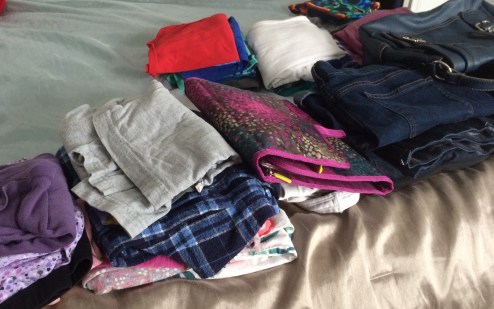
I am packing for Alaska now, and each item I put into a suitcase reminds me that I have to plan for the inevitability that at some point on this trip, my body or my mind will fail me. It is going to happen.
I keep my prescription medications, glucose meter and supplements in my carry-on bag. I cannot afford to lose these items. Also in the carry-on will be a 12-pack of dairy-free protein bars that can act as meal replacements or a quick fix for low blood sugar in an emergency. One of my few precious fluid ounces will be my Flonase.
One of our large suitcases holds winter jackets, gloves and hats. In some parts of Alaska it’ll be in the fifties and rainy, and my body cramps up wildly when the temperature drops too quickly. My ergonomic pillow will also be in that bag, so that I don’t wake up with back spasms each morning.
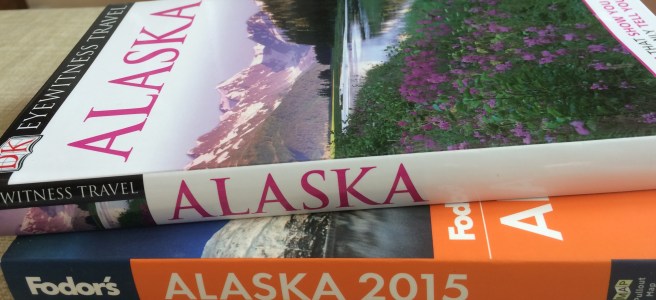
One bag will contain our guidebooks in which I have researched which restaurants near our hotel will have a diverse enough menu that I have a chance of finding dairy-free food. I have a grocery list and the address of the nearest Anchorage Target ready for when we land so that I can get enough non-perishable snacks to last me on a twelve hour bus tour of Denali and a 6 hour glacier tour out of Seward (lunch will be provided, but of course it all has dairy and if I go too long without eating at all I might pass out).
I bought seasickness bands for all of us because we’ve never been on the open ocean and I can’t handle being sick for 6 hours at a time.
We have backpacks, but I have to make sure I don’t overload mine, or my shoulders will cramp.
I can’t wear flip-flops anywhere where we will have to walk a long time, because my legs will cramp and my feet won’t uncurl.
I need to have ibuprofen available at all times, because even a storm rolling in can push me into severe pain (I have been checking the weather obsessively to try to steel myself).
I will bring make-up because there will be times I get very sick, and I don’t want to look very sick in our vacation pictures forever and ever.
I will bring my notebook with all of our information everywhere we go, because when I feel sick sometimes my brain goes foggy. When that happens I can’t remember simple words, nor can I figure out how to navigate my normal life much less a brand new environment. Knowing my brain is unreliable is scary, and then my anxiety kicks in making it even harder to take care of myself and small children.
Sigh.
All in all it sounds as if traveling is more trouble than it is worth. But if chronic illness has taught me anything it is that anything you want in life is going to take work. An uphill battle just means that the view from the top of the mountain is going to be that much more spectacular once you get there.
Puerto Rico was amazing and tropical.
Wisconsin gave me time when I could just enjoy being with my kids without nagging them about cleaning up toys or doing homework.
Kentucky gave me a chance to see family I love dearly and wouldn’t get to otherwise.
And Alaska? I have never had the chance to see anything like it. I don’t live near mountains, or the ocean, or moose or bears. I might never get the chance to see these things again. I want to see my kids’ faces light up when they touch a glacier, and my husbands eyes widen when he sees an orca. I want to feel the weight of a fishing pole as my son hooks a salmon. I want to smell salt-spray. I want a chance to see Denali.
I want to prove for myself that the trouble, the pain that goes into everyday life, and the pain and trouble of reaching for the extraordinary is always worth it.








 Kristin DeMarco Wagner