Mothers Always Write

MAW

Hi everyone!

I have an essay published on Mothers Always Write today called “Muffled”.  It is about my younger son and his struggles with speech delays and with not being able to hear well when he was three.  I would absolutely love for you to visit their website at

http://mothersalwayswrite.com/muffled/

They have many wonderful essays and poems through all the years of being a mom.

Thanks!

Kristin

I’m Fine

I'm fine

My oldest had a rough day at school last year. He ended up throwing up in a bathroom and was weaving around the hallways when a teacher who knew him noticed he looked green. She guided him to the nurse’s office and asked him how he was feeling.

He replied, “I’m fine,” in a nonchalant and off-handed manner. The teacher was stunned and amused, because he obviously was not fine. When she later told me the story of how this had all played out she felt so bad for him, but also thought it was endearingly funny. I did, too.

My youngest has a swollen cheek right now, and we think it’s from a six-year molar coming in and there being a little infected gum tissue. Yesterday he told me his jaw hurt, and when I asked if it still did today he said, “No.” I asked him if he was sure and his answer was, “If I distract myself it doesn’t hurt. As long as I don’t think about it.”

A bit exasperated I pressed further, “If you think about it, how does it feel?”

“It hurts.”

“So it does hurt?”

“Sure, it does. But not if I’m distracted.”

I think this is the legacy of having a parent with a chronic illness.

The boys have seen me throw up suddenly and move on with my day. They’ve known times when I was having trouble walking but still stayed with them at the park after school. They know that a lot of the time I don’t feel great, but I cope as well as I can. They say to listen to your body, and I absolutely do, but I have the added dimension that sometimes my body is a straight-up liar. It sends unnecessary pain signals all the time, it tells me I need a nap when really I need to exercise, it tells me I need tons of sugar when that will make me crash harder. So I ignore it. I power through. I tough it out.

The boys have started to do the same. We use the phrase, “It’s not the end of the world,” a lot in our household, that and, “It could always be worse.” We’ve gotten philosophical about pain and illness around here. I think our collective pain tolerance has gone up, unintentionally, and recalibrated. My oldest started out as a toddler who screamed bloody murder at the smallest scrape, and now throws up and claims, “I’m fine.”

But, surprisingly, now my boys also trust me when I tell them that they should probably stay home from school, or see a doctor, or get a flu shot. They used to try to tough everything out, going to soccer practice with a fever or pushing and crying for a playdate when they had been up coughing all night. They don’t do that anymore. It doesn’t seem heroic, it seems like suffering unnecessarily. Maybe they’re just older and wiser. Or maybe it’s because of what they see.

They see me nap, and rest, and exercise, and check my blood sugar, and prepare healthy food. Taking care of yourself when you are really too sick to power through is absolutely normalized. This is life, this is what people do. We push on when life isn’t that bad, when “it could be a lot worse”. When it gets worse we stop and rest and give our bodies a chance to catch up.

Since I have been having such a dysfunctional time of it with my body, I worried that the boys were going to end up with a dysfunctional relationship with their mostly healthy bodies. One day they will be the only ones monitoring the state of their health or illness. They should be off on their own some time ten or fifteen years from now, without a mom to check up on how they really feel. Luckily, I think we are inching towards balance, and I think that is because they have a sick parent, not in spite of it.

The Joy of New Clothes


New Clothes

“Nicholas just opens his drawer and takes whatever shirt!” Christopher is incredulous that his older brother, the one he looks up to, the one who was his first hero and the first person who was able to make him laugh, would be so cavalier about what he would wear.

Nicholas truly does not care much about clothing; his daily uniform of t-shirts and track pants changes only on special occasions, when we might be able to get him into jeans and a sweater. Even when he asserted his independence as a toddler, he truly didn’t fight us in the arena of “what to wear”, even though he was a fierce competitor in every other way. So, as he grew through to the eight-year-old he is today, we decided to take advantage of his not really caring all that much. When we go clothes shopping we have a plan that involves multiples of the basketball shorts, track pants and t-shirts he likes to wear. We hit one store for about an hour and a half every six months. Done and done.

Christopher gets these hand-me-downs, an extensive collection of not really well-thought-out, functional but not fashionable, interchangeable clothes. For a while he seemed to feel okay about them, as they were comfortable and usually were decorated with cartoon characters he liked. Then it wasn’t okay. Then came the showdown.

It was before a gymnastics class in the dead of winter. With polar vortexes and sub-zero temperatures, we would layer up like crazy before heading out somewhere. That particular day he had on thick socks, boots, long track pants, a long-sleeved t-shirt, a hoodie, a double-layered overcoat, a hat, a pair of gloves and a scarf.

Once inside the too-warm gym, (an environment well suited to keeping muscles from cramping and keeping little girls in leotards from getting a chill, but horrible for wearing sweatshirts) he took off his jacket and gloves but would not take off his hoodie. The flow of our morning stalled, and I was not thrilled about the ramifications of his refusal. Christopher can be incredibly stubborn, and we had been having a long winter of uneasy truces. I was picking this battle, and would see it through.

He crossed his arms and just stopped. I began by joking, “Christopher, you need to take your hoodie off, you silly goose, or you’ll roast to death during class!”

A grunt.

“Christopher, you are going to feel too hot and get too sweaty.”

Another grunt.

“Christopher Wagner, you are not going in there with that sweatshirt on, I am not going to let you.”

An anguished growl half under his breath.

“That is it! I have had enough! Why in the world won’t you take off your sweatshirt-you do every other class, every other time, what is going on with you today? And we’re not going to just stand to the side the entire class. You have one more minute to take that off or we are going home, young man!”

Tears.

“Are you taking off that sweatshirt?”

“NO!” He finally answered me in a yell. I grabbed his jacket and started feeding his arms through the sleeves, and silently sat at his feet shoving feet into boots. With a tense, almost whispered, “Get up,” from me, he got up. I zipped him, grabbed his hand and went out the doors. He didn’t protest leaving, and he tends not to. Christopher is fatalistic and grim when he accepts his fate, when he decides that he would rather accept the consequences of his stubbornness than acquiesce. I will say this for him, he has some sort of internal integrity that will not allow him to buckle under threat of missed classes, or no dessert, or zero screen time unless he knows he’s being ridiculous. When he sticks to his guns, I know it is very important to him. Once we got back to the car, I kept quiet and used the silence to cool off and hear myself think. After a few minutes, I ask him more gently, “Why, child, why? What was that all about?”

Finally unclenching he gave me an answer, “I don’t like football.”

What football had to do with anything I could not figure out. Then I realized that in a rush I had grabbed clothes for him that morning. We had little time to quibble about what he might or might not want to wear, so I ran upstairs, grabbed his brown track pants and the only brown shirt that went with them. The brown shirt had orange cleats on it and proudly proclaimed just one word in all caps “FOOTBALL”. And apparently my youngest does not like football.

And apparently he is very, very tired of misrepresenting who he is and what he likes. Because his options are limited to what his older brother liked just well enough to shove into a shopping cart two years ago, Christopher has had to lie about who he was. Our clothes communicate for us, and Christopher couldn’t take this miscommunication any more.

My husband, Greg, was the third of four boys and said, “Yeah, hand-me-downs save a lot of money, but it does stink. I never had new clothes, except for family pictures when Mom wanted us all to match. Let’s take him shopping, let him pick out things for himself.”

I introduced the idea to Christopher, and he was smiled and covered his mouth with his hand and then squeaked out, “Really?”

“Really.”

As we all stepped through the doors of a department store, Greg suddenly remembered, “Oh wait, guys. I need to get a couple of new dress shirts, can we head over there first? Then we’ll go to the kids section?” He looked to Christopher for the okay. Christopher nodded in agreement. The boys and I wandered around racks of leather belts and blazers while Greg held up a windowpane patterned shirt and asked, “Is this too much? Should I get it in a different color? Or the same color but a different pattern?”

Christopher found the tie rack and his eyes widened. He touched the vibrantly colored ties gently and showed me a swirl of color here or polka dot pattern there. Greg’s attempts to pick a shirt were interrupted with, “Daddy, you should get this one!” and “Daddy, you should get that one!” Christopher wanted so much that someone, someone he knew, would get to wear these beautiful, soft pieces of fabric he couldn’t contain himself. When Greg politely skirted the idea of buying ties one too many times, Christopher sighed quietly, “I wish I could use my money to have this.”

Wasn’t that why we were here in the first place? To get for Christopher clothing that he loved, that he wanted, that he felt wonderful in? I bit my lip trying not to smile too broadly and scare him away and said, “Sweetie, do you know that they make ties for little kids? And dress shirts, too? Do you want to go look for those?”

There have only been a handful of times in Christopher’s life that I have seen his face light up the way it did in the midst of the menswear section that day. A new possibility flashed into his consciousness that had seemed remote and unattainable before, and now he was told that not only did these clothes exist, but that he could get them for himself right then. There would be no waiting to see if a better coupon came in next week, no declaration that he probably didn’t need any more clothes because he had enough. I took his hand and guided him to the boys section of clothing, wooshing past the hoodies and track pants and athletic-themed t-shirts and right to the dress clothes put out for Easter. “Here we are!” I declared triumphantly and here we were.

We loaded our arms with multiple colors of dress shirts, a bouquet of clip-on ties and a couple of pairs of slacks and marched right over to the dressing room. I felt nervously excited as I helped button him up, as I tucked his shirt into his pants and clipped on his tie. He stepped back for a moment, looked himself over top to bottom and smiled, a huge, broad, unbelievable smile. He was amazed with himself, with the transformation he had gone through in the space of a minute. He pouted his lips and grabbed the knot of the tie with one hand, the length with his other and straightened it saying, “Men do this.” I covered my mouth with my hands and let my eyes keep smiling at him, “Yes they do, they do that.” A moment later he straightened his shoulders and said proudly, “I look like a scientist.” I suppressed a little laugh because I didn’t want him for a second to believe I was laughing at him, but my heart was jumping out of my chest. I had not realized that he had been quietly studying the clothing of the grown men around him, admiring how they held themselves and what their clothes represented. I hadn’t realized how completely happy he would be to wear that himself.

We left that day with white undershirts, three dress shirts in light blue, burgundy and white, five different ties, a pair of black slacks and a Lego watch, because his new mature look would have been incomplete without a watch. We left the store with a very, very happy five-year-old.

Pain and Joy

willis tower

This essay was intended as the beginning of a monthly column, a pitch for a well-regarded online literary journal.  As I mapped that series out, I decided that these were ideas I wanted to write about regardless of whether they were accepted and published elsewhere.  They weren’t picked up, which is disappointing, but I’ve decided that the first Wednesday of each month will be when I continue the column for myself.  That’s my intention, at any rate, and we will see how that goes.  Thanks!  

My two sons, Nicholas and Christopher, are eight and six respectively. My chronic illness began when Christopher was just a year old, so by all accounts they have known a mother with pain far longer than they have known her without.

The first blood tests were drawn out of my fat, left-arm vein when Christopher was still small enough to fall asleep in his car seat and was portable like a piece of awkward and heavy luggage. Nicholas was squirmy and independent at three, and I couldn’t trust him to not run through the parking lot if I let go of his hand. Christopher swung from my left arm and Nicholas from my right, and I shouldn’t have gotten the three of us from the doctor’s office to our car that way. I bruised an ugly purple in the crook of my left arm later that night.

That was the beginning. Tests for diabetes and allergies and rheumatoid arthritis followed, as well as screenings for ovarian and colon cancer, and an MRI to look for multiple sclerosis. I was eventually diagnosed with fibromyalgia: a disease of exclusion. The answer to my near-constant pain and overwhelming exhaustion was a non-answer because fibromyalgia has no known cause and no cure. The term “fibromyalgia” might really be an umbrella over several linked but separate illnesses, or it might have its own pathology that hasn’t been discovered yet.

For at least five years I fought every day to mitigate the pain I felt and the pain I thought I might be causing them by being a mother who sometimes couldn’t. I fought to minimize our pain as a family and that became my full-time job. I was a stay-at-home mother for both Nicholas and Christopher their wholes lives, but my real work was to track down the root cause of why any of us were hurting.

I have become very, very good at spotting pain from a distance of space or time. I can hear Christopher’s tone of voice change across an entire playground if he is starting to get so agitated that he might hit a friend, and I know that once we have missed three nights of bedtime stories in a row Nicholas’s shoulders will round and slump in defeat and loneliness. I am honed in on pain, and aggravation, frustration and tears and the fleeting expressions that betray those emotions. This was something I could do, I could see pain as clearly as I could see the color of someone’s hair. This was a way I could still help, even from the couch. I had information about how to mitigate pain in many different forms, from migraines and cramping muscle spasms to loneliness and perfectionism. What I didn’t yet know, I found out. What I did wrong, I corrected. What I knew, I shared as often as I could. I found a way to contribute.

Over time, one of my symptoms became more severe. It wasn’t so odd that suddenly my limbs felt like they were filled with sand, but it was odd that it was happening so often. A feeling would come over me that I could not keep my body upright and that I had to lay down immediately. When I realized it was often after I ate, I researched that combination. Reactive hypoglycemia seemed to be the reason why: after eating too much or too much of the wrong foods my blood sugar would spike too high, prompting my pancreas to produce too much insulin which would make my blood sugar sink too far down. Since I have done stranger things than eating small regular meals and avoiding sweets, I decided to try a hypoglycemic diet.

More good days than bad, was how I had been describing my fibromyalgia. But the good days still included wild fluctuations of anxiety and depression. The good days still might mean that I fell asleep on the couch for an hour when I didn’t even realize I was tired at all. The good days meant that I didn’t growl all through soccer practice, but I might growl a lot when the boys took too long in the bathtub afterwards. Then a bad day included a Mother’s Day where Nicholas asked me over and over again what special thing I wanted to do and eventually I hissed at him, “I don’t feel well. I don’t know if I’ll still feel this bad all week and I cannot afford to feel bad all week. It’s my Mother’s Day, what I want is to clean up the kitchen, to put the laundry away, to take care of chores now. I want to know that we’ll be fine for the rest of the week. That is what I want. Is that all right with you?” Something had to change.

I changed my diet, and I felt good. Actually good. It lasted longer and longer. I felt better and better. My good days now included spontaneously taking the boys to the pool and not experiencing the gnawing fear that I wouldn’t have enough energy to now make it through the day. My good days meant fourteen hundred words of writing in one morning, when fourteen hundred would have been a stretch for an entire week. My good days meant I could tickle Christopher and wrestle with him and not hide the tears that would have normally stung my eyes seconds before I would have had to tell him, “I’m so sorry, but I can’t anymore. I’m hurting too much.”

I had lived so long mitigating pain and had become so adept at devising strategies to cope, it was the skill I had honed the most. It was a skill and a body of knowledge I shared with my family and shared with friends and shared with strangers. It became a constant in my life: seeing and helping to ease pain. That was primarily what I did, all day long.

All that time I was a student of pain I wasn’t necessarily a student of joy. I felt fairly certain that joy was, for me, obtainable only in small measures, and I felt content looking for it in small places. On a daily basis joy meant, simply, less pain. If I could achieve that for myself or anyone else I was happy that the limited amount I could do, I did. Now I have passed that limit. I feel much, much, much better. A part of me feels guilty that I do. A part of me wants to learn joy.

I want to share with you what I have discovered about pain. I don’t want the five years I spent in pain, the majority of my children’s lives, the primary hard work I did during that time to become lost. There are times and situations where less pain is the only joy you can reach for today.

And I want to share what I am learning about joy. Because I want to share joy.

The End of Kindergarten

Giraffe

I’ve been noticing more about my youngest child lately. I’ve been paying more attention to him, taking mental pictures more often, remembering cute things he does more often.

He just turned six. A few weeks ago he held my hand in the parking lot as he clacked along to soccer in his cleats. He held onto his water bottle and kicked his size 4 soccer ball down the path. My purse was slipping off my shoulder and under my other arm I tried to press sunscreen and another water bottle and bug spray to my body so that they wouldn’t clatter all over the pavement. At the edge of the blacktop he kept holding onto my hand. A bolt of lightening hit me saying, “He might never do this again, he is so close to not needing or not wanting this anymore.” I struggled to keep holding onto him as long as he would let me, even though everything else I had kept falling.

We only have a few weeks of school left, a few weeks where it is just him and me all morning long, just a few weeks before the time I get with him is always and forever shared with his older brother. Next year is first grade, and I have to share him with a whole series of teachers. In the afternoons I’ll have to share him with soccer and chess and whatever else interests him: new friends, books, computer games.

These are the last few times I will take him to the library on a weekday morning, just the two of us. These will be the last weeks of eating lunch together while watching Blue’s Clues or Phineas and Ferb or Curious George.

Today he asked me to dance around the kitchen with him.

Today we put some of his summer clothes on a stuffed giraffe while he got dressed.

Today he rode around the block on a too-small Dusty Crophopper bicycle with training wheels while I followed behind.

Today he asked if I could come into his classroom to see the baby chicks that had hatched.

Today he let me give him a goodbye kiss as I dropped him off at school, even as he asked if he could take the bus next year.

I am going to miss this so much. It won’t be the same again. I know it’ll be okay, but while I had been telling myself over and over how much it was going to be okay, I didn’t realize just how deep my sadness really was.

I have been so lucky to have had this time that I have.

So lucky. Thank you, everyone and everything that has let me have this.

Inspiration and Execution

Sunday Morning

A conversation with children at 7:00 AM. It is a chilly winter morning, and two young boys ages 8 and 5 beginning interrogating their harried mother.

Youngest: Don’t we have any dreidels?

Mother: Well, no. We don’t.

Youngest (cries as if heart is broken)

Mother: What on earth???

Youngest: I want to collect dreidels.

Mother: I…uh…huh?

Oldest: So I just made up this drum set. How long did Fleetwood Mac practice before they were rock stars?

Mother: I…huh…what? Do you mean Mick Fleetwood? I don’t know, what did they say on the show?

Youngest: (still crying)

Mother: (switching attention rapidly between one child and the next) Ok, kiddo, we just don’t have dreidels. It’s not the end of the world, sweetie, really it’s not.

Oldest: Wanna hear my new song I made up? Can I take drumming lessons? How long do you need to take drumming lessons?

Mother: I…uh…huh…what?

I have to be careful what sorts of TV shows I watch with my kids. It is not about violence, or sex, or even foul language. The above transcript comes from a morning where my boys watched a recorded episode of CBS Sunday Morning with me. This episode featured interviews with Mick Fleetwood and an older gentleman who owns the world’s largest collection of dreidels. Other episodes convinced the boys that they wanted to sculpt huge sandstone caves, create street art, start a bakery, and become comic book authors. Some days I am not up for how excited the boys are.

Mother: (just too tired to think straight) That is IT! We cannot do everything! These people, the people on these shows spend their whole lifetimes doing what they do-we CANNOT replicate what they do in the space of a morning. We are not going to pout about it either. Just, everybody CHILL OUT!

But, most days, I am able to appreciate the way a segment on a show can ignite their imaginations. And I am a little jealous. I have found them designing huge pumpkin sculptures (with trick-or-treat buckets and stuffed animals) after watching Halloween Wars. They’ve made River Monsters out of Legos and blocks and boats out of kitchen chairs. We made a turkey-shaped sugar cookie at Christmas because a contestant had on Holiday Baking Championship. Every room of the first floor was commandeered recently for a live-action game of Boom Beach that went on for two hours.

Come to think of it, it really isn’t just TV shows. Sometimes it’s video games, apps, zoos, restaurants, songs, books. Everything can become a game, or a new dream to pursue, or a book they need to write.

One of my favorite days was right after we had been to The Museum of Science and Industry. We had seen the recovered submarine U-505 there. The next day they decided to play Battleship, which seemed reasonable as we’ve had that board game forever. When I came into the playroom, they had set up a fortress wall that divided the whole room in half. Homemade boats studded the sea of carpet. They threw stuffed animals at each other to sink the other person’s makeshift navy. And once a boat was sunk (they assured me no one on board was hurt) the boats were hauled away to be “museumed”.

I miss childhood and the way you can run off with an idea as soon as it pops into your brain. I get tired of having to postpone a project for dirty dishes, e-mails to the boys’ teachers and calls to refill prescriptions. I’m tired of waiting weeks and weeks between inspiration and execution. I’m frustrated with rainy days and budgets and tax appointments and laundry, but I suppose most adults are. I try not to let my jealousy peek out too often, because I am absolutely glad that this is something the boys can have, that I can give them now. As adults, as far as I can tell from myself and most other adults I know, they’ll still get a million ideas but they will have less time to actually do anything with them.

This post, alone, has been a nebulous idea that has floated around in my brain for at least a year and a half. And I have had a stolen hour Monday and a half hour this morning to get anything that made any sense written down. And that was only available because the boys saw a YouTube clip of a Hot Wheels track in a bathtub that they wanted, on Monday night, to try for themselves.

What Are You Afraid Of?

Alien

“There was this incredible crashing noise, like a huge stack of heavy boxes falling over. I went running around the house making sure no one was crushed and never found what it was. Then it happened again that same night. Again, nothing had actually fallen over.” My brother is one of the first people I tell strange phenomena to, because he is the likeliest of all my family and friends to explore all the possibilities with me.

“Whoa. Ghost?” He seems concerned, but practical.

“Maybe a poltergeist?” I actually sound a bit hopeful.

“That doesn’t seem like it would be comforting.”

“But it is!” I can sense my brother raising an eyebrow over the phone, “Poltergeists, well according to Wikipedia, tend to be manifestations of one person’s stress. So, I just need to relax. If it’s a ghost or something then I have no control over bumps in the night. This way, I do!”

“Yeah, still not a comforting thought.”

I would rather have a poltergeist in my house than a ghost. My brother would rather a ghost than a poltergeist. My oldest son, when asked if he was afraid of ghosts one Halloween, furrowed his brow in confusion. “Ghosts are just dead people,” he said. Seeing as he is generally not afraid of live people, this makes sense. But it doesn’t.

Fears are so idiosyncratic. I used to believe that every fear someone had made sense, or had a contextual backstory that explained it away. I am scared of crossing train tracks. I live in the suburbs of Chicago and there are a whole bunch of Metra stations and tracks everywhere. I had heard stories of people dying at crossings. When I was a child in the backseat of a mini-van, I had no control over the speed of our car or when I could cross to safety. When I have had to walk over tracks, I am painfully aware of how slow and clumsy I am.

I am scared of large dogs because for a few summers I worked as a mail carrier. A huge German Shepard that roamed an otherwise empty house day in and day out lunged for me and ripped through a screen next to my head.

I still have nightmares about velociraptors because of Jurassic Park.

These fears make sense.

But I am scared of heights with no clear reason. Arriving late for almost anything starts a low-level anxiety pit in my stomach that can grow quickly to fill my chest cavity. I can swim, but drowning fills my nightmares.

I’ve come to realize that some fears have no clear context, that maybe the quirks of what we fear are largely inborn. Just like our favorite and least favorite foods are decided by a mysterious combination of the chemicals in our brains and the way we’ve been exposed to snacks, maybe our fears work the same way. Some make sense and others don’t.

Take my two sons. They are only two and a half years apart. Almost all of their formative life experiences they have had so far in this world have been together. Raised by the same people, taken on the same vacations, enrolled in the same school, exposed to the same movies and TV shows and video games, they probably have more similarities than differences. But…

The oldest hates rollercoasters, but loves huge water slides.

My youngest loves rollercoasters and HATES water slides.

My oldest is afraid of spiders and heights.

My youngest will be going to a camp this summer mostly to see spiders, and climbs to the top of every playground.

My oldest went water tubing at the age of six and stayed out behind the pontoon boat as long as we would let him.

My youngest, sitting on the boat, absolutely refused. But when he saw teenagers jumping off cliffs into the lake he asked if he could, too. At four.

At the very least it fascinates me to know that for almost every fear we have, rational or not, there is probably a counterpoint. For every fear that has us paralyzed, there is someone who is just amazed or thrilled by it. And the things we take for granted as manageable (I am not afraid of dentists or doctors or public speaking, for example) could be terribly daunting for someone else.

I have always been terrified of the idea that aliens may exist. I want to watch shows about it, but find myself chickening out at the last moment. At any given time there is probably an episode of Ancient Aliens waiting for me in the DVR, biding its time until I am brave enough to conquer it.

My oldest, at eight, has commented on that particular fear of mine.

“I am much more worried that there are no aliens. That will really are alone in the universe. That scares me. We’re the only ones alive in the whole universe? Totally by ourselves?”

I consider this for just a second. “But, what if they are dangerous or evil aliens?” I ask because that is the only possibility I can imagine. “If those are the only creatures who are out there, that doesn’t seem very comforting.”

“But,” he looks at me with that furrowed brow again, “it means someone else is out there. It is.”

Not What I’m Supposed To Be Doing

Sometimes I feel overwhelmed. I know I am not the only one who is balancing on that fine line between “okay” and “not okay”. This week brought one kid’s winter cold, another kid’s blood drawn, six nights of bad sleep for everyone in the house, a holiday, too much fast food, a day off of school for another holiday and most likely a day off of school for freezing cold. And my crown popped off in a Valentine’s Day caramel. All of these are small things, taken individually, but they’ve pushed me into “I am going to sit and stare into space until I figure out what to do or until elves come and solve every problem for me” mode. I have to say, I am always hoping the elves show up soon, because I am not the best at prioritizing what needs to happen next when everything needs to happen at once.

When overwhelmed, I tend to pick the most absurd chore I can find. I tackle it for one to two hours. I feel immensely better and more in control of my life, though in reality I’ve squandered a lot of precious time and energy.

Last week I cleaned every baseboard on the first floor of our house. Some spots were immensely dusty and grimy, but not anymore! Never mind that you can’t even tell now because so much clutter is obscuring it.

The week before I tackled personal grooming-I scrubbed and buffed and shaved and moisturized. I used every beauty product in my arsenal. The next night I forgot to take off my makeup so I had raccoon eyes and the clogged pore beginnings of pimples by morning.

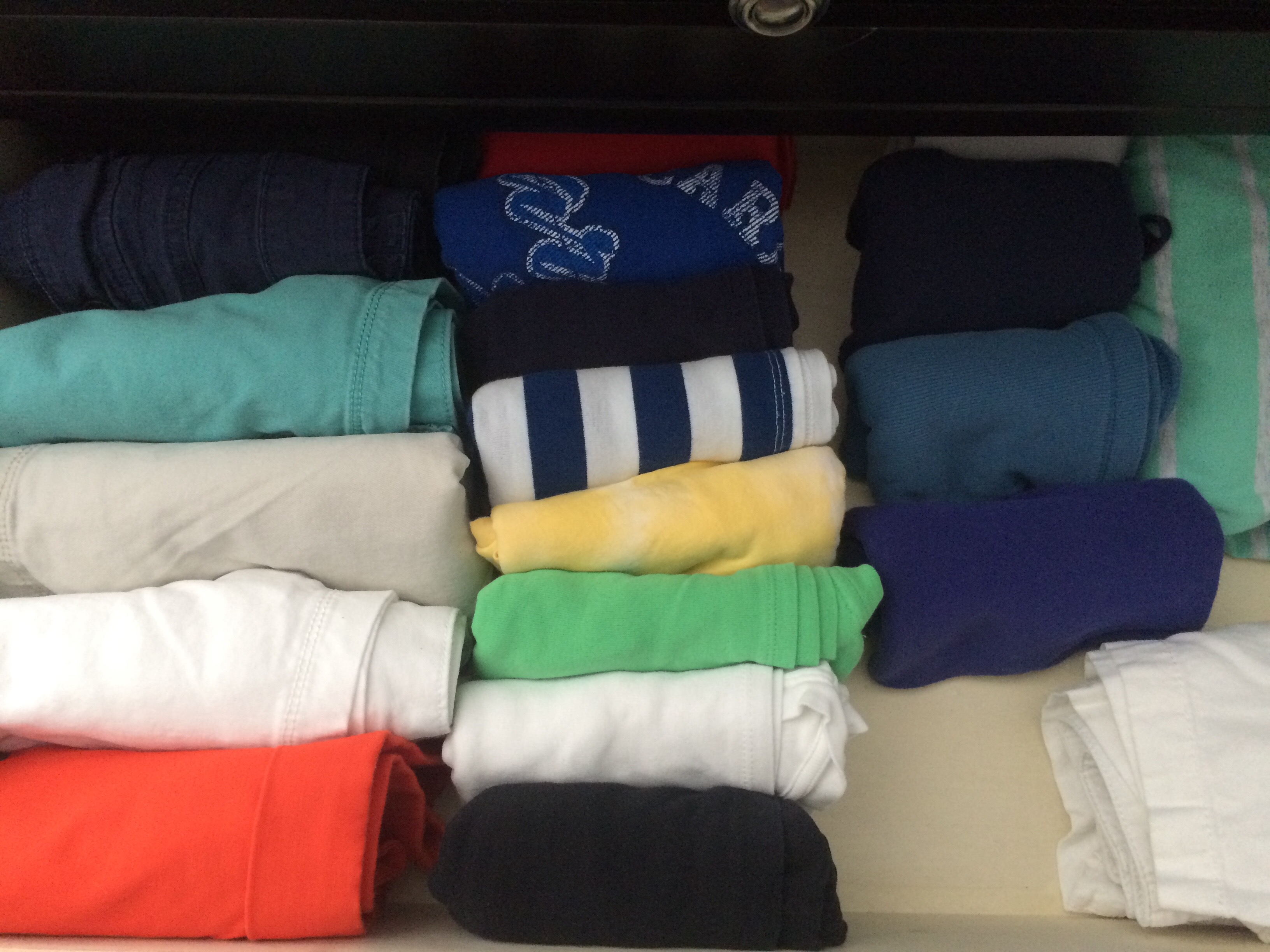
This week I had been reading a book on decluttering which, among other things, suggested that socks have a very hard life, living as they do between foot and shoe all day. My socks need to rest, and should not be balled up so uncomfortably. Also, my t-shirts would be so much happier folded in a kind of a roll, not piled up on each other. So this week, I tried to make my clothes more comfortable.

folded

The winner, though, in the “This is the most unnecessary task I can think of at this point in time, and I will do it thoroughly and with gusto” award goes to…sorting through every single one of the eighty-two episodes of Wild Kratts that live in our DVR. About two weeks before Christmas, with almost every hour planned out to make sure we didn’t miss a present, an event, or a holiday memory, I started going through them. It had irritated me that some episodes were mislabeled, some were repeated, and it took extra time to find the one we wanted. So, I wrote down the name of every episode, I fast-forwarded to see if the title was correct, I deleted duplicates. I don’t want to tell you how long I spent doing this. It was longer than any other random project I’ve decided to tackle on a weekday while feeling overwhelmed. It feels silly to admit, but it felt good that something was in order.

wild kratts

Next week, I’m hoping things go a lot more smoothly. If not, I am wondering if I’ll feel like the most important thing in the world is to sort through my eight-year-old teaching materials, or research 101 dairy-free crockpot recipes, or maybe comb the DVR for errant Peg + Cat episodes.

At least we only have 30 of those.

Poultry

poultry

My youngest child has always had a fondness for birds, though as I try to trace it back I can’t quite describe when it began.

When I was pregnant with his older brother, I dreamt that my little baby was a songbird. I don’t know that I ever shared that story with the boys.

His older brother’s favorite stuffed animal since birth was a large penguin named Narnie.

I sing the song “Little Bird” from The Man of La Mancha every night as I tuck them in. It begins, “Little bird, little bird, in the cinnamon tree…little bird, little bird, please take pity on me…”

When my youngest turned four I began calling him my duckling. His soft light hair reminded me so much of a baby bird’s pin feathers.

We have a bird feeder, though quite often we forget to fill it. Near our house we have seen red-winged blackbirds and Canadian geese, robins and cardinals, finches and seagulls, herons and red-tailed hawks.

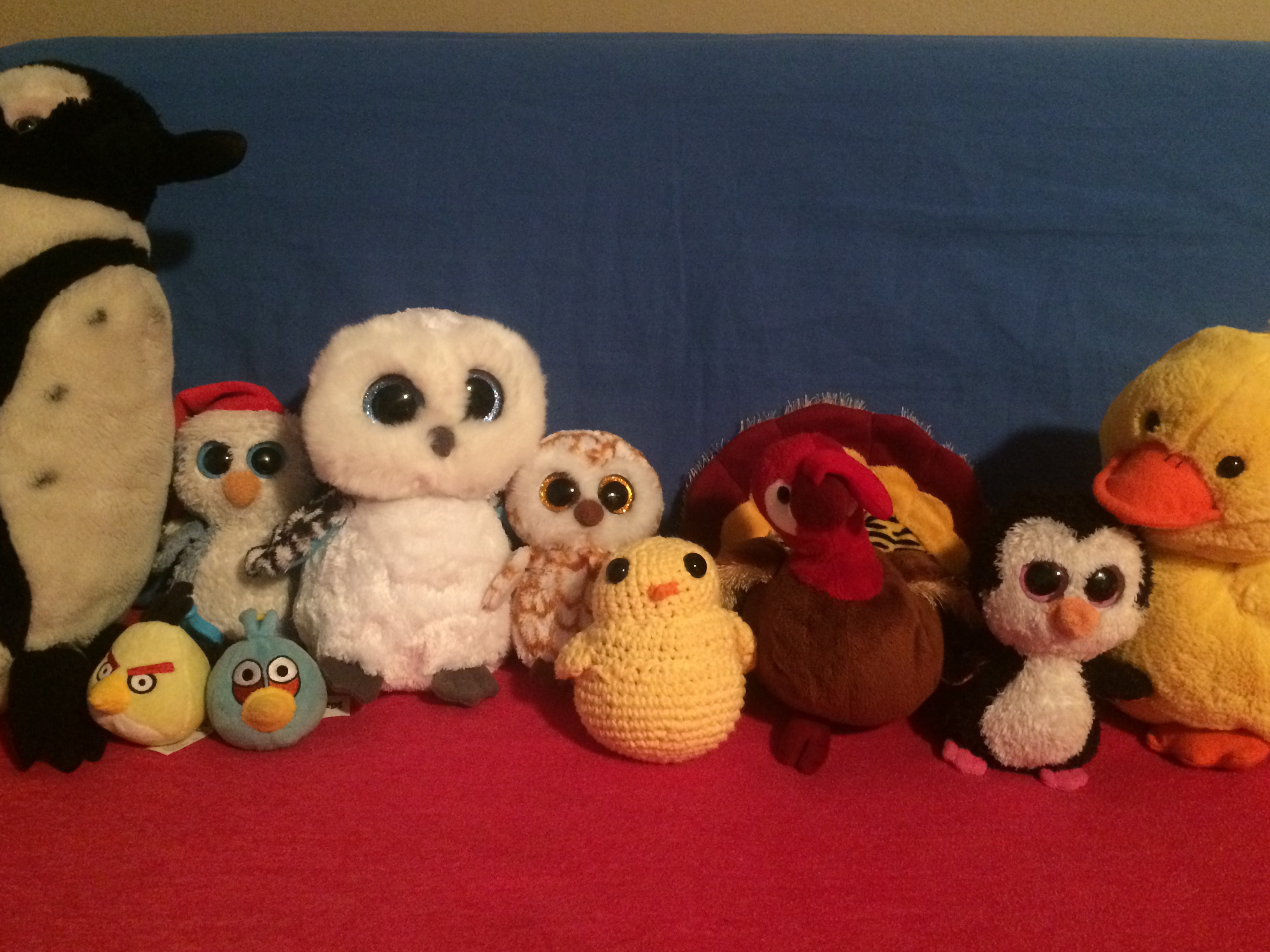
My youngest has a collection, now, of stuffed animals that are birds. There are a mama and baby owl set named Snowy and Syrup. There are huge ducklings, smallish penguins, a chick and even a wild turkey. The birds nearly always keep the coveted stuffed animal spot on the bed, and rarely see the inside of the toy chest.

I suppose it was just a natural progression of his fondness that two weeks before Thanksgiving he suddenly found it unbearable to think of chickens and turkeys being eaten. I admit that all the billboards and television cooking shows made his sadness thicker. Everywhere there were raw birds, golden birds, chefs advising ways to tuck back wings and tie up legs. The carcass of a bird was identifiable as the body of something missing a head and stripped nude. He cried, quite often.

For those two weeks, and a few weeks after, he would not touch chicken or turkey, though both had made up half of his dinners before. We shielded him from seeing our Thanksgiving turkey as much as we could, and at the long dinner table that night he got to sit next to his uncle who is vegan, and revel in being with a like-minded soul.

In the midst of it all I wondered aloud with him if one thing that troubled him was the language we use. When we eat beef we don’t say were having “cow”. When we eat pork or bacon or ham we don’t automatically call it “pig”. I asked him if it would help him at least feel less sad if we called chicken and turkey “poultry”. He agreed that it would, that he would not have pictures in his head of a live chicken and a dead chicken at the same time.

As a whole family we’ve had more vegetarian meals lately, and also more beef and pork overall when we do eat meat. When we go to fast food restaurants I ask the boys if they want “Poultry Fingers” or hamburgers or mac and cheese. At home for dinner we still sometimes have “Poultry Vesuvio” or “Poultry Cacciatore” or “Barbeque Poultry Baked Potatoes.”

The word “poultry” seems to soften his stance on not eating “poultry” – since we started using that word he will sometimes choose the fingers or have a bit shredded in a soup. And while it buys me some time to get him acclimated to healthy vegetarian food and makes life a little easier from meal to meal, I feel dirty. I have marketed chicken differently, and so hidden the parts that are so objectionable to my five-year-old, and made it okay for him again. I am wondering how much longer I will hold out using the word “poultry” before I decide to say “chicken” or “turkey” again. When I switch back I have to be prepared that might be the end of my child eating meat and some radical changes are going to be happening around here.

He is developing empathy for other living creatures, and I cannot be mad at that.

The day before Thanksgiving he and his brother made posters about saving endangered species, protecting the food chain, discouraging hunters.

One says, at the top, “Do not hurt animals”.

Another of the posters asked, “Do you promise?”

I promise to try, my duckling.

I promise to remember that birds are your friends.

I promise to be respectful on that day when you finally do tell me you won’t be eating poultry ever again.

Spanish – Italian Lessons

Farfalina

“So, Mommy, did you know that farfalina is Spanish for butterfly?”

“Um, what? No, that can’t be right.”

I have a horrible know-it-all habit. Whenever my kids tell me something new they’ve learned that isn’t totally accurate I feel compelled to say, “Actually…” and then I correct them.

“Actually, mariposa is Spanish for butterfly. I thought I remembered that from high school Spanish. I mean, give me a second and let me look it up but, no, yeah, no, farfalina is Italian.”

I am not sure why I have to be right all…the…time…

“Yeah, kiddo, I’m looking at my phone now. Farfalina is like the word farfalle, you know, the bow-tie pasta that looks like butterflies? Who told you it was Spanish?”

“Our neighbor.”

“But she’s Italian! She learns Italian words all the time. Why would she say it was Spanish? Spanish and Italian are both based in Latin and they are similar languages, but in this case they are different. I even had a student named Mariposa in Texas, who was Mexican-American and I had asked her about her name.”

My eight-year-old tried to defend her by saying, “Well, maybe I remembered it wrong.”

I finally stop talking and let him wander off to brush his teeth. In the quiet I realize something.

“Well, maybe I remembered it wrong.”

That’s what it is.

That is why I keep badgering him, why I can’t stop being right. That’s what I am afraid of, not that he remembered something wrong, but that I have started to remember things wrong.

A few years ago I had an MRI of my brain. We were looking for dark spots that might indicate a tumor, or perhaps Multiple Sclerosis. I had been losing words mid-speech, writing sentences that didn’t make sense and assuming I had read something correctly when I hadn’t. I felt drunk when I hadn’t had a drop. I tasted salt when there was none. I nearly scalded the boys because when I tested their bath water I couldn’t feel how scorching hot it was. I could no longer assume that any part of my brain was allowing me to process or understand the world correctly.

We didn’t find anything wrong.

I was later diagnosed with fibromyalgia, which mostly means that the doctors don’t quite know what is going on. Without understanding the mechanisms of it, many of us get a sensation called “fibro fog” which pulls a mist around our minds and makes it hard to function. I don’t get this sensation as often as I used to, though for a while it was such a part of daily life that I felt I might have Alzheimer’s. It only happens once in a while now, but when you can’t read to your kindergartener without transposing a bunch of words, it is still quite disconcerting.

With regards to my cognitive function, everything I’ve learned (or thought I learned) since I first started having symptoms is suspect. I often think I’ve filed new information in the correct part of my brain only to realize later on that I haven’t. When I find I might be wrong, I scramble like mad to check my facts by searching my memory and the internet. I do detective work to reassure myself that I didn’t screw it up.

So going on and on about the many ways I was absolutely certain that mariposa was the Spanish word for butterfly and farfalina was Italian felt necessary. It felt good to be able to track so many neural pathways that brought me to the same conclusion – I was right. It felt so good to know that I haven’t totally lost my mind, at least not yet.

But…

I know this isn’t a good thing to be doing to my kids, whatever reason I might have for doing so. And now the boys do the same thing to me. I’ll make a comment about how pretty the full moon is and I get…

Actually, it isn’t full yet. It won’t be for another day.”

Or I’ll compliment one of them on a drawing I assume is just a bird and get…

Actually, this is a Peregrine Falcon. Couldn’t you tell by the talons and how he’s swooping down with lines behind him like he’s really fast?”

It drives me crazy! I can’t say anything without being corrected for being inaccurate. My know-it-all karma has given me back know-it-all kids. Fibromyalgia or no fibromyalgia I have got to slow down this impulse to inform and correct before it gets even more out of hand.

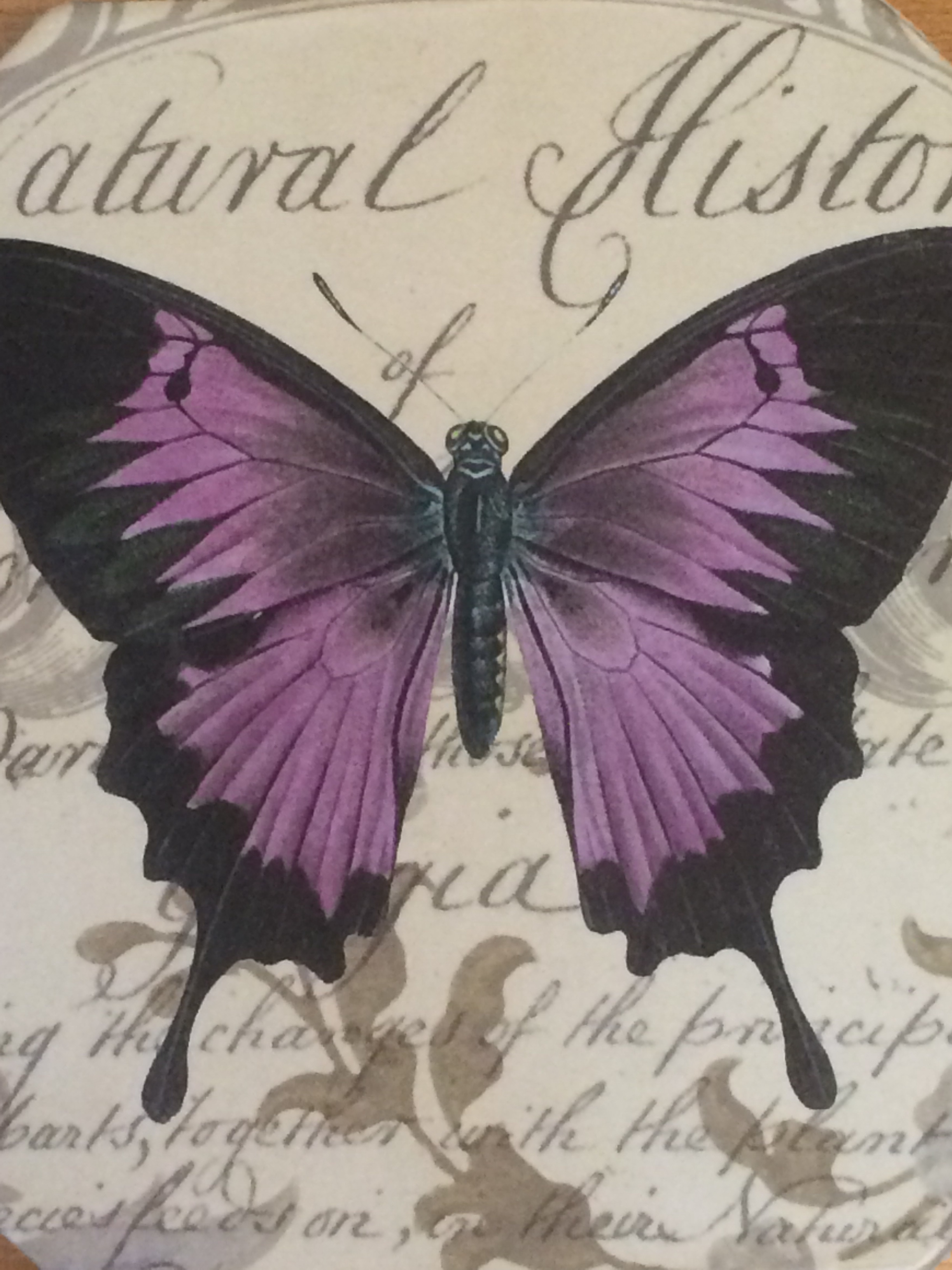
But, actually, did you know that the Spanish word for fibromyalgia is just fibromialgia? And that the Italian is exactly the same? And that a lilac-colored farfalina is its symbol?

Maybe I can’t be stopped.