The Pain of Not Being Able to Communicate

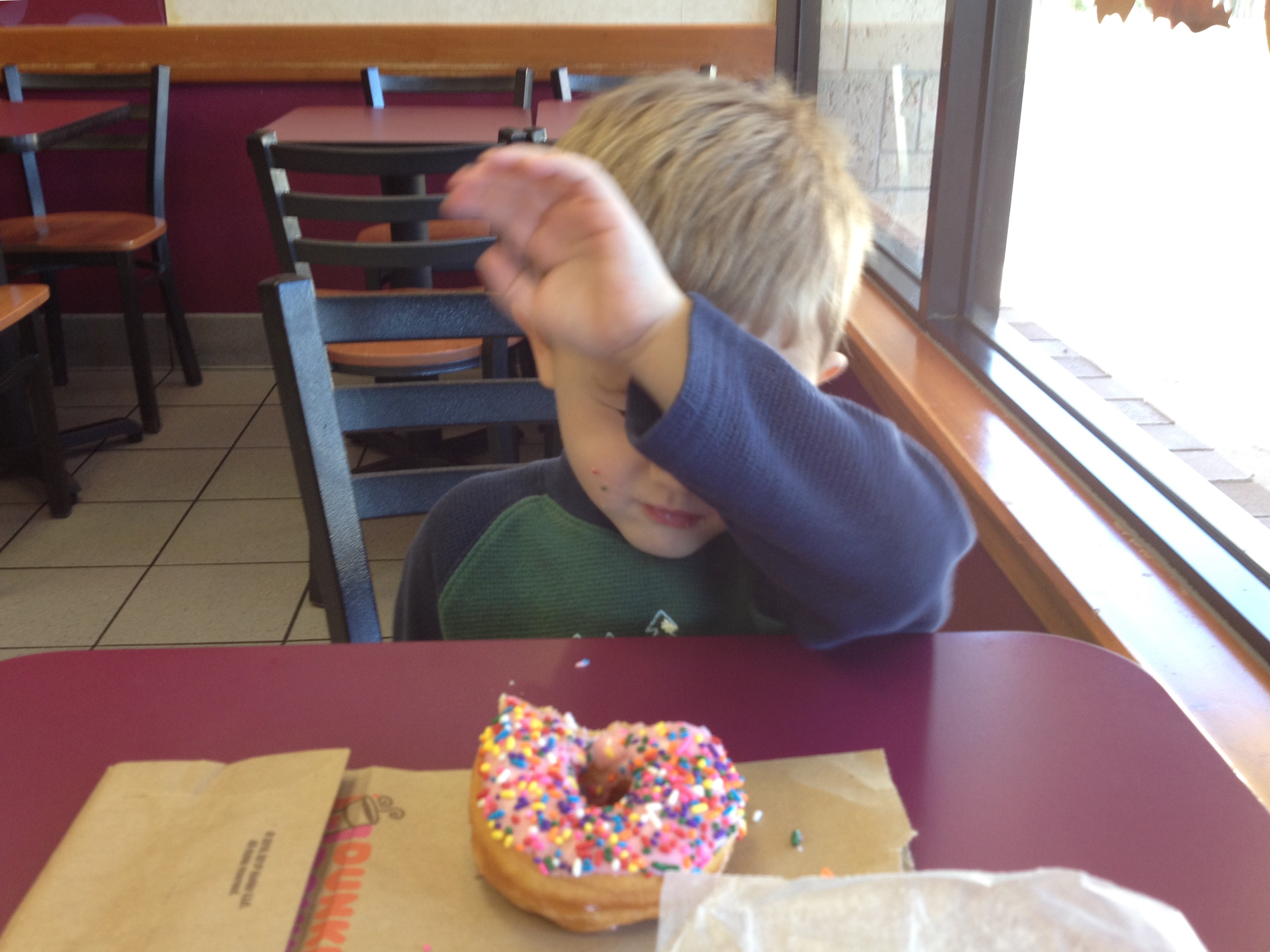
donut

This is the second installment of my column Pain and Joy.  I plan to continue on with it the first Wednesday of each month, so wish me luck!

Christopher, Nicholas and I sat on the couch, their pointy elbows pressed into my ribs, and their pointy chins digging into each of my shoulders as they tried to crowd in to get a better look.

“How come Christopher is always so cute in pictures, and I’m not?” Nicholas wanted to know.

“Kiddo, this album is from 2011, and you would have been four – that cute kid is you.”

Nicholas looks sheepish and pleased with this realization, but also surprised, “I was so little!”

“Hmmm, yeah guys, this is Christopher,” I point at a picture of a toddler with impossibly chubby cheeks sitting in a red plastic wagon, “He would have been one and a half here.”

Christopher, so mature and lanky at six years old, lets out a squeal over how cute he was, while I notice a pattern to our pictures. “Hey, what’s up with you, here? In every other picture you are completely crabby!” Actually, in three out of four pictures he looks either completely unimpressed with life or, as Thomas the Tank Engine might say, quite cross.

Giggling hard he gasps, “Why was I so angry?”

“I know, right?” I goof with him, flipping pages rapidly, “Cranky, cranky, cranky, happy! Cranky, cranky, cranky…”

When Christopher laughs now his cheeks still get round and full. He’s now laughing so hard that he is slightly out of breath and…

“Happy!”

He lets out a long sigh and wipes his eyes.

I didn’t realize how much of his unhappiness from that age would have come through in those pictures. I do know why he was angry, or rather I can guess. Long past when he should have started, Christopher either couldn’t, or perhaps wouldn’t, talk.

Christopher was, and is, wonderfully adept at reading people’s faces, at discerning the tone of their voices and at understanding the nuances of gestures. As a toddler he could express himself non-verbally almost perfectly. His body language transmitted his mood exactly, and he brought his whole body into sadness or frustration or manipulative charm. He knew to direct your eyes to where he wanted you to look by staring you full in the face, and then directing his gaze at what he wanted. His sighs and squeals and yells were unmistakably clear, but that was it. He didn’t babble. He only had one word by the time he was two.

I knew he was angry that he couldn’t get us to understand what he meant or what he wanted, or more importantly, needed. We would begin a ridiculous guessing game. It was a lightening round of 20 questions, where I would survey the situation, scan my memory for what he would be most likely interested in, and ask a yes or no question. I hoped like hell that I asked the right one before his frustration detonated. If he shook his head “no” too many times steam would practically pour out of his head before he began stomping his feet, and I would frantically try to get it right before he would collapse in a sobbing heap on the floor in utter hopelessness. Or his tantrum would be quieter, with him simply stopping in his tracks, refusing to look up and refusing to walk forward another step.

Christopher began speech therapy after he turned two.

The Halloween he turned two and a half, I had been wondering out loud what his costume should be. I had grown accustomed to making these decisions for him, as he rode quietly in the seat of the shopping cart. I picked up a little faux leather jacket and muttered to myself that he could be a rock star. Christopher paused in what he was thinking about to focus his eyes on me and said very, very clearly, “Dog.”

I was stunned. This was the first time, the absolute first time, he was able to calmly express that my ideas for him were not the ideas he had for himself. Just one word, one syllable; the access to that one word gave him power. That one word gave him the ability to feel secure in his message, to feel secure enough in his ability to be understood that he didn’t have to scream. He didn’t have to cry. I didn’t have to guess, and guess wrong. I blubbered, “Of course you can be a dog! Of course you can be a dog.” He smiled, a very quiet serene smile.

Christopher turned three in April, and the volume of the words he could use had exploded. At his meeting with the school district, the evaluator said that he was no longer delayed, but he could continue with the program for pronunciation help and emotional support. His tantrums were no longer something that dominated our days, though he still didn’t have quite enough words to communicate everything that went through his mind, so they did still happen now and then.

In May, I brought the boys over to my parents’ house to visit and tell my mother that they loved her, now that both of them could. I dropped them off at my in-laws to stay the night, as my father and brothers and I would be helping Mom through open heart surgery the next morning.

When Mom’s surgery was successful, and after she had been in the recovery room for the initial few hours, we were allowed to see her, two at a time, in the ICU. I don’t remember who went first. I know Dad was one of the first two, and then maybe one of my brothers Scott or Matt or Anthony. She was not awake the first time I saw her. The second time I came in I know Matt told me, “She seems happy when you hold her hand.”

So I did, and as I held her left hand I thought about what she might be feeling. Her face was flushed and scrunched and looked distressed. I wondered if she felt anxious about the breathing tube still being in place. I wondered if she was feeling pain from the incision, or if she felt worried about her Parkinson’s meds being off, or if there was a part of her that felt scared or lonely. Then she tried to wriggle her fingers out of my hand. At first I held tighter. She seemed to be trying to break free of my grip, and I chastised myself that perhaps I had been patronizing and she didn’t need my hand.

Confused, I then tried to release my hand, and Mom, with limited motion because of all the equipment attached to her, waved it back and spread it open. She traced something on the palm of my hand, and I looked up at her face with surprise, “Are you trying to write something?”

She blinked her light green eyes so deliberately I knew she was nodding yes.

“H…” I would look down at my hand to make sure that the letter I felt was what the letter actually looked like. I had so many years of practice when she would trace the alphabet on my tiny back and I would proudly tell her that I knew what she was writing. As I said each letter I looked up at her face to confirm I had gotten the letter right.

“O…T. Hot?” I looked up at her and with a softening of the tension in her face she indicated yes. Just one word, one syllable and her power came back. I wrenched myself away from the soft fuzzy imaginings of what she might be feeling, and was able to focus on the practical things that needed doing. My ideas about her were not the ideas she had herself. I played twenty questions with mom, “You feel too hot? It’s really uncomfortable?” Then I would ask the nurse, “Can we remove that blanket? Is this normal to feel so hot?”

By then I know Anthony was in the room with me, and I would call out letters to him so he could help me string them together coherently.

“T…A…P…E”

“The tape is bothering you? The nurse says we have to keep that on, its holding the breathing tube in place, I’m sorry.”

“I…P…O…D”

“Oh yeah, the soothing meditation sounds for afterwards. We’ll get that set up right now.”

“C…A… wait I missed that one, you have to slow down a little because I can’t keep up…H…B? Okay Mom, the nurses need to you to relax for a little while to get deep breaths to get your oxygen levels up.”

When Mom breathed deeply enough, she would fall asleep and her oxygen levels would drop, which meant waking her up again. I explained the situation to her and she wrote in my hand one more time before I was shooed away. I was so tired I couldn’t catch it. “Tell me later, Mom. You can tell me later.”

Later on she told me with a smile, “I’m surprised you didn’t get that one. I was writing ‘Catch 22’ joking about what the nurses wanted me to do with the breathing.” I smiled back at her and apologized for missing it.

The same way I had apologized so often to Christopher, “I’m so sorry I didn’t understand you.”
Look, a Peep!

I love artists!

This might be a sort of obvious statement for me, along the lines of, “Oxygen is really wonderful stuff,” or “Since I have to eat every day, I’m really happy someone invented food” But, I do feel like it needs saying every once in a while.

I love all sorts of artists for the color and life they bring to the world, the unexpected juxtapositions of imagery and meaning, the metaphors and the details. The melancholy mood of Billie Holiday’s “Foolish Things”, or the violent wind that seems to shake Van Gogh’s White Roses, or William Butler Yeat’s “rough beast” that brings in a nightmare in “The Second Coming”: all are wonderful and terribly beautiful and full of imaginative life. I am transported by a vision or a feeling that I would have never arrived at without the compulsive need of an artist to create. It is amazing.

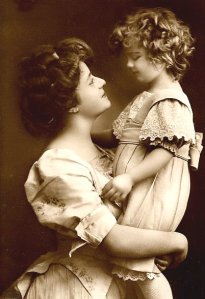
But, I also love artists for entirely selfish and narcissistic reasons. I love when I can see myself, my life, or what is important to me in the art around me. I love that this unknown photographer abandoned stuffy parlor portraits to capture this mother.

Mother and Child

I think that one of my friends finally softened into trusting me after see the same look on my face as the mother in this photograph has. For the first few weeks I knew my friend, she saw only my furrowed brow and heard only my scolding towards my children. Eventually I let my face soften into the same face in the picture, and I could feel her soften, too. Across a century I see myself.

I love that these animators chose to draw George and the Man with the Yellow Hat this way.

George

This comes from a longer episode of Curious George about Halloween. In this still, George has just been told that a frightening legend may have some truth to it. He grabs the Man’s face and stares hard into his eyes.

My oldest child’s birthday is towards the end of October, and whenever we go to the party store to find decorations for his celebrations we are bombarded by macabre costumes and props: knives and skeletons and blood and gore. My youngest could not bring himself to walk through this store, so I always carried him. When a motion detector would trip ghoulish noises, he would grab the sides of my face in his chubby tiny hands and straighten my head so that I could only stare into his eyes. I could not determine if he was trying to protect me from the scary things all around us, or if he needed steady, unwavering reassurance from me. How amazing that that gesture is universal enough that it made its way into this animation.

My youngest son recently got a book for his birthday, a book he loves and which contains a page that describes the protagonist child’s favorite dessert. On a plate, next to an elaborate and beautiful cake, is a small Peep chick. As soon as he caught it he yelped out loud and pointed at it and laughed and laughed. A Peep! Look right there! I love Peeps!

peep

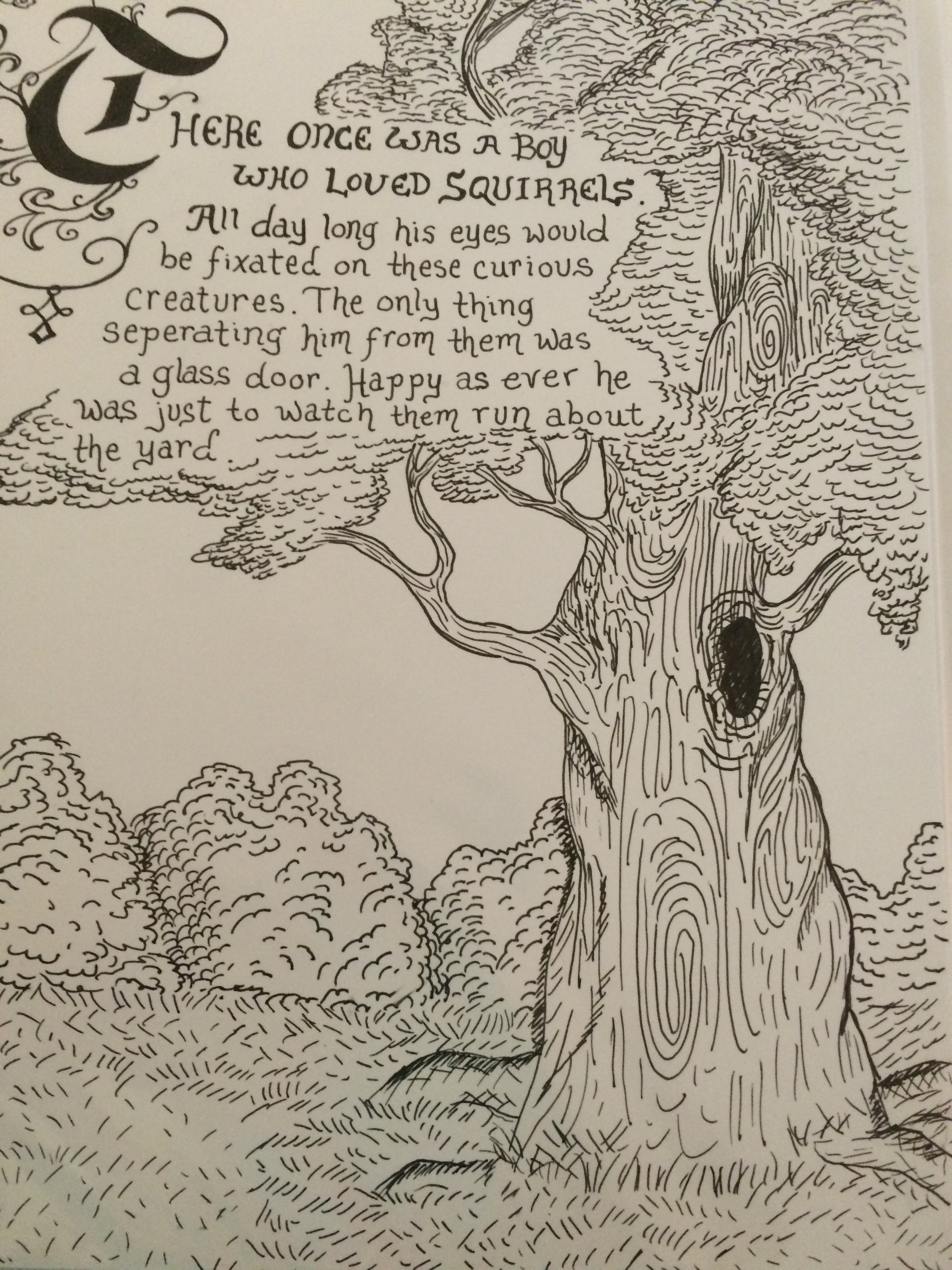
He recognized himself in the pages of this book, and it made him fill with delight. Someone else who loves Peeps as much as he does, this character. I’m not sure if I should tell him that this particular book was inspired by him in the first place. My brother wrote it and my future sister-in-law illustrated it with him and his love of squirrels in mind. So the Peep was intended as a nod to him from the beginning, and when they saw him see it for the first time, they both lit up.

SquirrelSquirrel 2

Seeing yourself in art never gets old. To see a piece of what you know and have lived reflected back to you, to see something that felt important to you lovingly captured in photos or drawings or poems or songs, it is a kind of magic. The kind of magic that makes you feel less alone and less apart from the rest of the world.

But, Only Hipsters Have Triangle Tattoos

Maslow's

I am certainly not a hipster.

I also do not have any tattoos.

Yet.

But, lately, the tattoo I have been planning out in my head is a simple striped triangle. A representation of Maslow’s Hierarchy of Needs.

My teacher friends might remember this concept from back in developmental psychology courses. The basic idea is that we are all motivated by irreducible needs, and that once we meet our basic needs we are able to climb higher to try to achieve more lofty ones. The concept is framed as a pyramid.

The base layer of the pyramid contains our basic biological and physiological needs – our need for air, water, food, shelter, sleep. These needs have to be met for us to move on to the next level.

The next level up contains our need for safety – protection from danger (whether that danger is a poisonous snake, a tornado, or a criminal), law and order, stability.

The level after that contains our need for love and belonging – friendship, affection, intimacy, romantic love, family.

The level after that contains our need for esteem – self-esteem, mastery, achievement, independence.

The level after that contains our cognitive needs – stretching our brains, learning, finding meaning.

The level after that contains our aesthetic needs – appreciation for, the search for and the creation of beauty.

The level after that is our need for self-actualization – becoming the highest version of yourself you are capable of becoming.

The last level is the need for transcendence – overcoming the limitations of human needs and human forms. It is complete spiritual fulfillment.

This seems like an orderly way to explain the motivation of human beings, that once the bottom rung of needs are met then we can seamlessly turn our attention to the next level and so on and so forth. When I turn back to this model in times of chaos, it provides me with a way to get my life back under control. When the pain or fatigue or depression that can be associated with fibromyalgia begin to severely limit my ability to function, I go back to the pyramid. I go back to the basics and make sure I take care of each level I can in order. It helps.

It also gives me an organizing principle for deciding what is most important for my children, for my family. Food, water, sleep, shelter first. We are very lucky that the first needs are securely taken care of. Safety is always next. This is such a part of our life that I can yell out to them at any given point, “What is my number one job as your mommy?” and they will yell back, “To keep us safe!” If there is a question of priorities, those win.

It helps stave off bad behavior, usually. Most tantrums come about when basic necessities are off – the boys haven’t eaten in a while, they stayed up too late, they feel sick and need rest and medicine. My youngest had a tantrum this morning because his need for safety was not being met to his liking. He thought he would have to get a shot at his doctor’s appointment when he did not. Once he felt safe (all of his vaccinations are up to date and he needed no boosters) the rest of the day fell into place.

This helps me prioritize what charities we support with the little extra we have. Charities that feed and clothe and shelter people get our attention first. Charities that keep people feeling safe and loved next. Charities that teach after that.  If you can do all of those at once, even better.

I taught in a public school and can tell you first hand how difficult it is for a child to learn if his basic needs, his need for safety or his need for belonging are not being met. Any programs that provide breakfast and a safe environment should be protected. Any wonderful people who can make a student feel like he or she is meant to be right there with them, who can make a student feel safe and accepted, should be truly appreciated. Then mastery and learning can happen. Not before. The pyramid as an organizing principle makes sense again.

But, and this is very, very important, we as humans are not always orderly. A shock, I know. We sacrifice having basic needs met to hit those higher levels. There are examples everywhere. We lose sleep night after night after night going for a promotion. We eat a plate of fries when the problem is not that we are hungry, but that we are lonely. We let obsessions with mastering a level on a video game run over our loved ones. We skip meals to fit into a gorgeous dress because we want above all else to be beautiful. We often choose to meet needs out of order.

And, if under extreme circumstances there is little to no possibility of having our basic needs met, we strive to fulfill any of the needs we have any chance of meeting. Gang members may find their need for belonging is stronger than their need for safety. During unspeakable horrors like the Holocaust, people have turned to learning and appreciation of beauty as the only needs they could fulfill or help others fulfill. Countless people have had to look at transcendence as the only need they could hope to meet in the midst of war or starvation or natural disaster. Our needs are irreducible.

I want a visual reminder that every person alive on earth has real needs.   A reminder that my needs are real, that the needs of other people are real, that meeting those needs is imperative. I want a reminder that this organization of those needs has often helped me and others, and I feel anchored by it.

I want a simple, striped, triangle tattoo.

I also would really, really like it if this tattoo didn’t also scream to the world, “I wish I were a twenty-something hipster who loves the clean lines of geometric shapes” when I am really a thirty-something conventional mom and former educator who actually prefers photo-realistic tattoos of things like flowers and insects and birds.

But,

That isn’t a real need.

What Are You Afraid Of?

Alien

“There was this incredible crashing noise, like a huge stack of heavy boxes falling over. I went running around the house making sure no one was crushed and never found what it was. Then it happened again that same night. Again, nothing had actually fallen over.” My brother is one of the first people I tell strange phenomena to, because he is the likeliest of all my family and friends to explore all the possibilities with me.

“Whoa. Ghost?” He seems concerned, but practical.

“Maybe a poltergeist?” I actually sound a bit hopeful.

“That doesn’t seem like it would be comforting.”

“But it is!” I can sense my brother raising an eyebrow over the phone, “Poltergeists, well according to Wikipedia, tend to be manifestations of one person’s stress. So, I just need to relax. If it’s a ghost or something then I have no control over bumps in the night. This way, I do!”

“Yeah, still not a comforting thought.”

I would rather have a poltergeist in my house than a ghost. My brother would rather a ghost than a poltergeist. My oldest son, when asked if he was afraid of ghosts one Halloween, furrowed his brow in confusion. “Ghosts are just dead people,” he said. Seeing as he is generally not afraid of live people, this makes sense. But it doesn’t.

Fears are so idiosyncratic. I used to believe that every fear someone had made sense, or had a contextual backstory that explained it away. I am scared of crossing train tracks. I live in the suburbs of Chicago and there are a whole bunch of Metra stations and tracks everywhere. I had heard stories of people dying at crossings. When I was a child in the backseat of a mini-van, I had no control over the speed of our car or when I could cross to safety. When I have had to walk over tracks, I am painfully aware of how slow and clumsy I am.

I am scared of large dogs because for a few summers I worked as a mail carrier. A huge German Shepard that roamed an otherwise empty house day in and day out lunged for me and ripped through a screen next to my head.

I still have nightmares about velociraptors because of Jurassic Park.

These fears make sense.

But I am scared of heights with no clear reason. Arriving late for almost anything starts a low-level anxiety pit in my stomach that can grow quickly to fill my chest cavity. I can swim, but drowning fills my nightmares.

I’ve come to realize that some fears have no clear context, that maybe the quirks of what we fear are largely inborn. Just like our favorite and least favorite foods are decided by a mysterious combination of the chemicals in our brains and the way we’ve been exposed to snacks, maybe our fears work the same way. Some make sense and others don’t.

Take my two sons. They are only two and a half years apart. Almost all of their formative life experiences they have had so far in this world have been together. Raised by the same people, taken on the same vacations, enrolled in the same school, exposed to the same movies and TV shows and video games, they probably have more similarities than differences. But…

The oldest hates rollercoasters, but loves huge water slides.

My youngest loves rollercoasters and HATES water slides.

My oldest is afraid of spiders and heights.

My youngest will be going to a camp this summer mostly to see spiders, and climbs to the top of every playground.

My oldest went water tubing at the age of six and stayed out behind the pontoon boat as long as we would let him.

My youngest, sitting on the boat, absolutely refused. But when he saw teenagers jumping off cliffs into the lake he asked if he could, too. At four.

At the very least it fascinates me to know that for almost every fear we have, rational or not, there is probably a counterpoint. For every fear that has us paralyzed, there is someone who is just amazed or thrilled by it. And the things we take for granted as manageable (I am not afraid of dentists or doctors or public speaking, for example) could be terribly daunting for someone else.

I have always been terrified of the idea that aliens may exist. I want to watch shows about it, but find myself chickening out at the last moment. At any given time there is probably an episode of Ancient Aliens waiting for me in the DVR, biding its time until I am brave enough to conquer it.

My oldest, at eight, has commented on that particular fear of mine.

“I am much more worried that there are no aliens. That will really are alone in the universe. That scares me. We’re the only ones alive in the whole universe? Totally by ourselves?”

I consider this for just a second. “But, what if they are dangerous or evil aliens?” I ask because that is the only possibility I can imagine. “If those are the only creatures who are out there, that doesn’t seem very comforting.”

“But,” he looks at me with that furrowed brow again, “it means someone else is out there. It is.”