Losing My Food Mojo

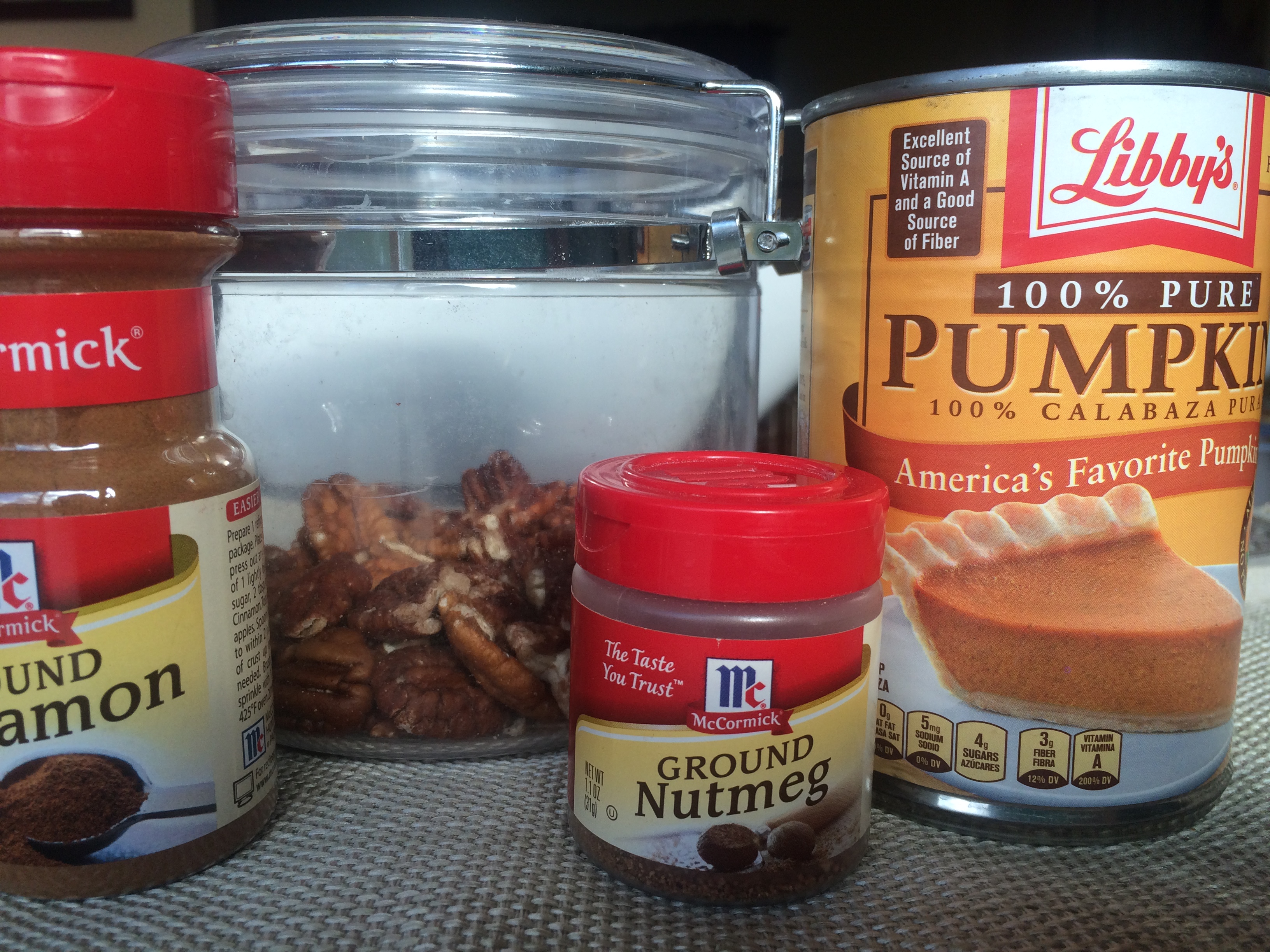
Pumpkin Pie

My kitchen luck had run out last winter.

In rapid succession, over the course of seven to ten days, I…

  • Left a seventeen dollar pot roast sitting on the floor of our kitchen overnight. How, you may ask? It was still sitting in its Target bag, and pretty much any time we go grocery shopping one or two bags manage to escape being put away. The white and red bags filled with batteries or toothpaste live on the floor until I remember to take them upstairs where they belong, but I have never stepped over perishables before.
  • Destroyed another seventeen dollar hunk of meat. The second pot roast, left to cook in our crockpot, confirmed our fear that our crockpot only works on high. The meat languished on low for ten hours and was still nearly raw. I tried to save it on high and rendered it totally inedible.
  • Got such bad hand cramps before a party I couldn’t cut a strawberry. A strawberry!
  • Found honey on the couch and floor and absolutely no recollection of how it got there.
  • Made chicken and dumplings that were so salty we all courted high blood pressure.
  • Dropped a carton of eggs.
  • Cut my finger while taking the rind off ugli fruit.

And…

  • Ruined gnocchi. Gnocchi is a pasta dumpling that takes two to three minutes maximum to cook in boiling water. I have made pasta at least once a week for the last fifteen years. As a child, I was the official pasta tester for our family and made sure it wasn’t under or overcooked. If there was one thing in the world I was sure I couldn’t screw up, it was pasta. Instead of becoming dinner, the gnocchi all clumped together and bloated, like a pale, water-logged, dead fish. I pulled the mass out and had to bury it in the garbage can.

I was raised Catholic so the next step, once I admitted that perhaps I did have a cooking problem, was to figure out which saints might be able to help me out. I did some internet research and tried appealing to…

  • St. Anthony the Abbott – Patron Saint of Bacon
  • St. Drogo – Patron Saint of Coffee
  • St. Elizabeth of Hungary and St. Nicholas – Patron Saints of Baking
  • St. Luke, St. Augustine and St. Nicholas (again) – Patron Saints of Beer
  • St. Zita and St. Martha – Patron Saints of Housekeeping
  • St. Charles Borromeo – Patron Saint of Stomachaches
  • St. Michael the Archangel – Patron Saint of Grocers

And…

  • St. Lawrence – Patron Saint of Cooking

Eventually my bad luck ended, though I cannot say whether it was with or without divine intervention. I was reminded of this because Thanksgiving is coming up. Although these days I am pretty non-denominational, I am not above asking saints for a little help.

We’ll be feeding almost twenty people at our house in about a week. We’ll be working with our tiny kitchen, my dietary restrictions around dairy and corn syrup, the vegetarian options we make sure to have for my brother, the turkey that always fills the house with smoke but then turns out fine, the lovely wine my mother-in-law brings that I’ll dip into too early, the cranberry-walnut-bourbon Jello my mom brings that I’ll also dip into too early, and the fact that my youngest child now bursts into tears at the thought of eating birds. It seems like a good idea to do some preventative praying.

So…

Dear St. Lawrence,

I was hoping you could watch the pots and the oven a little, so I could feed my family and friends as well as I am able, and so I can take some time to appreciate what I’ve got. Please keep us free from burns and scalding and broken glasses. Please watch over the fridge to make sure nothing spoils, and the oven to make sure nothing burns. Please make sure the soy whipped cream is enjoyable, and that the real whipped cream doesn’t get trapped in its can, causing a small riot. I know you’re probably pretty busy, but thank you so much in advance.

Sincerely,

Kristin Wagner, in the Chicagoland area
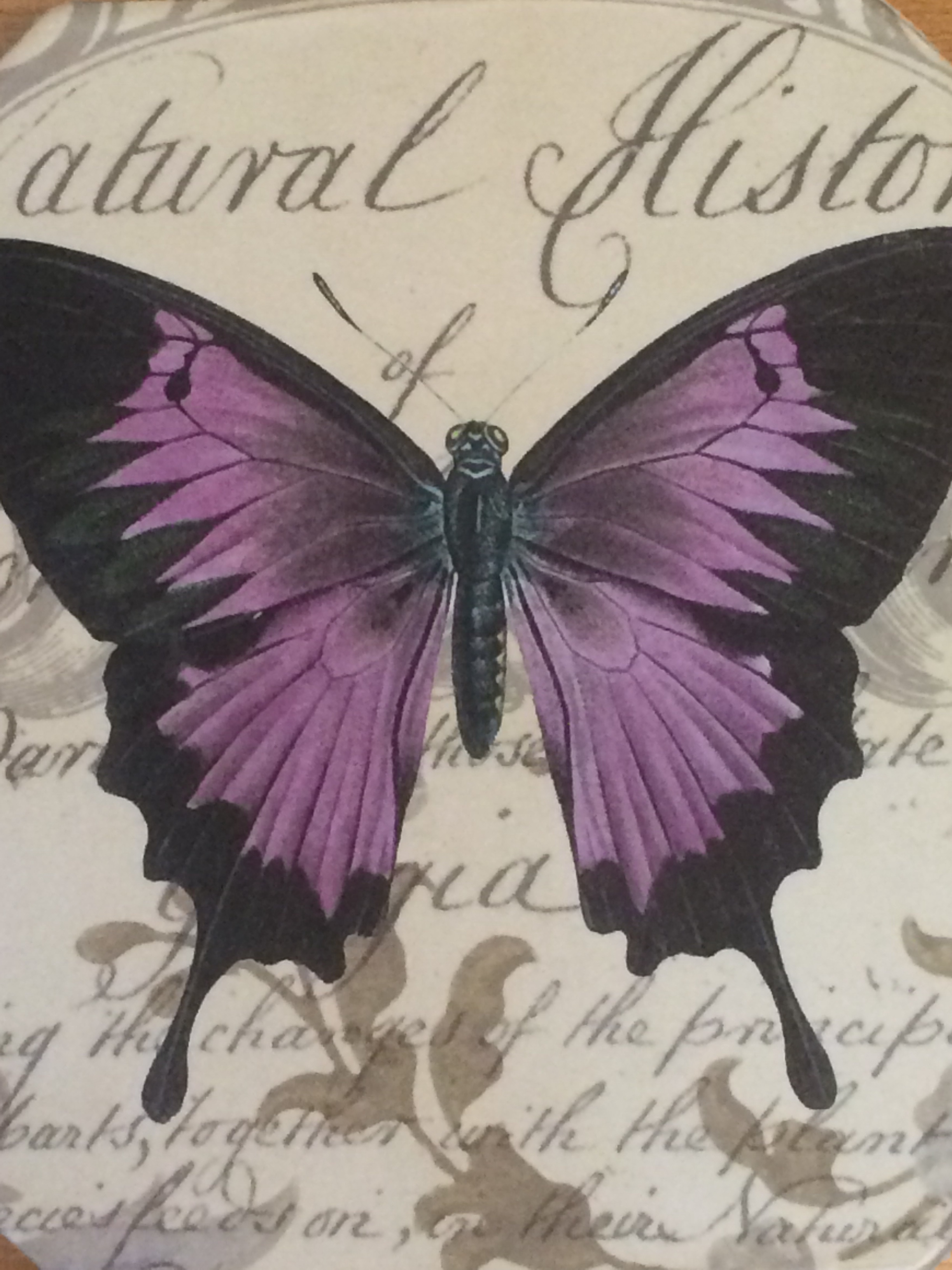
Spanish – Italian Lessons

Farfalina

“So, Mommy, did you know that farfalina is Spanish for butterfly?”

“Um, what? No, that can’t be right.”

I have a horrible know-it-all habit. Whenever my kids tell me something new they’ve learned that isn’t totally accurate I feel compelled to say, “Actually…” and then I correct them.

“Actually, mariposa is Spanish for butterfly. I thought I remembered that from high school Spanish. I mean, give me a second and let me look it up but, no, yeah, no, farfalina is Italian.”

I am not sure why I have to be right all…the…time…

“Yeah, kiddo, I’m looking at my phone now. Farfalina is like the word farfalle, you know, the bow-tie pasta that looks like butterflies? Who told you it was Spanish?”

“Our neighbor.”

“But she’s Italian! She learns Italian words all the time. Why would she say it was Spanish? Spanish and Italian are both based in Latin and they are similar languages, but in this case they are different. I even had a student named Mariposa in Texas, who was Mexican-American and I had asked her about her name.”

My eight-year-old tried to defend her by saying, “Well, maybe I remembered it wrong.”

I finally stop talking and let him wander off to brush his teeth. In the quiet I realize something.

“Well, maybe I remembered it wrong.”

That’s what it is.

That is why I keep badgering him, why I can’t stop being right. That’s what I am afraid of, not that he remembered something wrong, but that I have started to remember things wrong.

A few years ago I had an MRI of my brain. We were looking for dark spots that might indicate a tumor, or perhaps Multiple Sclerosis. I had been losing words mid-speech, writing sentences that didn’t make sense and assuming I had read something correctly when I hadn’t. I felt drunk when I hadn’t had a drop. I tasted salt when there was none. I nearly scalded the boys because when I tested their bath water I couldn’t feel how scorching hot it was. I could no longer assume that any part of my brain was allowing me to process or understand the world correctly.

We didn’t find anything wrong.

I was later diagnosed with fibromyalgia, which mostly means that the doctors don’t quite know what is going on. Without understanding the mechanisms of it, many of us get a sensation called “fibro fog” which pulls a mist around our minds and makes it hard to function. I don’t get this sensation as often as I used to, though for a while it was such a part of daily life that I felt I might have Alzheimer’s. It only happens once in a while now, but when you can’t read to your kindergartener without transposing a bunch of words, it is still quite disconcerting.

With regards to my cognitive function, everything I’ve learned (or thought I learned) since I first started having symptoms is suspect. I often think I’ve filed new information in the correct part of my brain only to realize later on that I haven’t. When I find I might be wrong, I scramble like mad to check my facts by searching my memory and the internet. I do detective work to reassure myself that I didn’t screw it up.

So going on and on about the many ways I was absolutely certain that mariposa was the Spanish word for butterfly and farfalina was Italian felt necessary. It felt good to be able to track so many neural pathways that brought me to the same conclusion – I was right. It felt so good to know that I haven’t totally lost my mind, at least not yet.

But…

I know this isn’t a good thing to be doing to my kids, whatever reason I might have for doing so. And now the boys do the same thing to me. I’ll make a comment about how pretty the full moon is and I get…

Actually, it isn’t full yet. It won’t be for another day.”

Or I’ll compliment one of them on a drawing I assume is just a bird and get…

Actually, this is a Peregrine Falcon. Couldn’t you tell by the talons and how he’s swooping down with lines behind him like he’s really fast?”

It drives me crazy! I can’t say anything without being corrected for being inaccurate. My know-it-all karma has given me back know-it-all kids. Fibromyalgia or no fibromyalgia I have got to slow down this impulse to inform and correct before it gets even more out of hand.

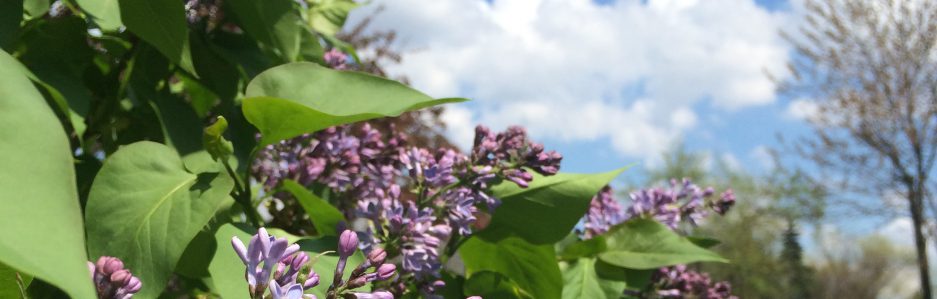
But, actually, did you know that the Spanish word for fibromyalgia is just fibromialgia? And that the Italian is exactly the same? And that a lilac-colored farfalina is its symbol?

Maybe I can’t be stopped.

Jack-O-Lanterns and the Beauty of Temporary Art

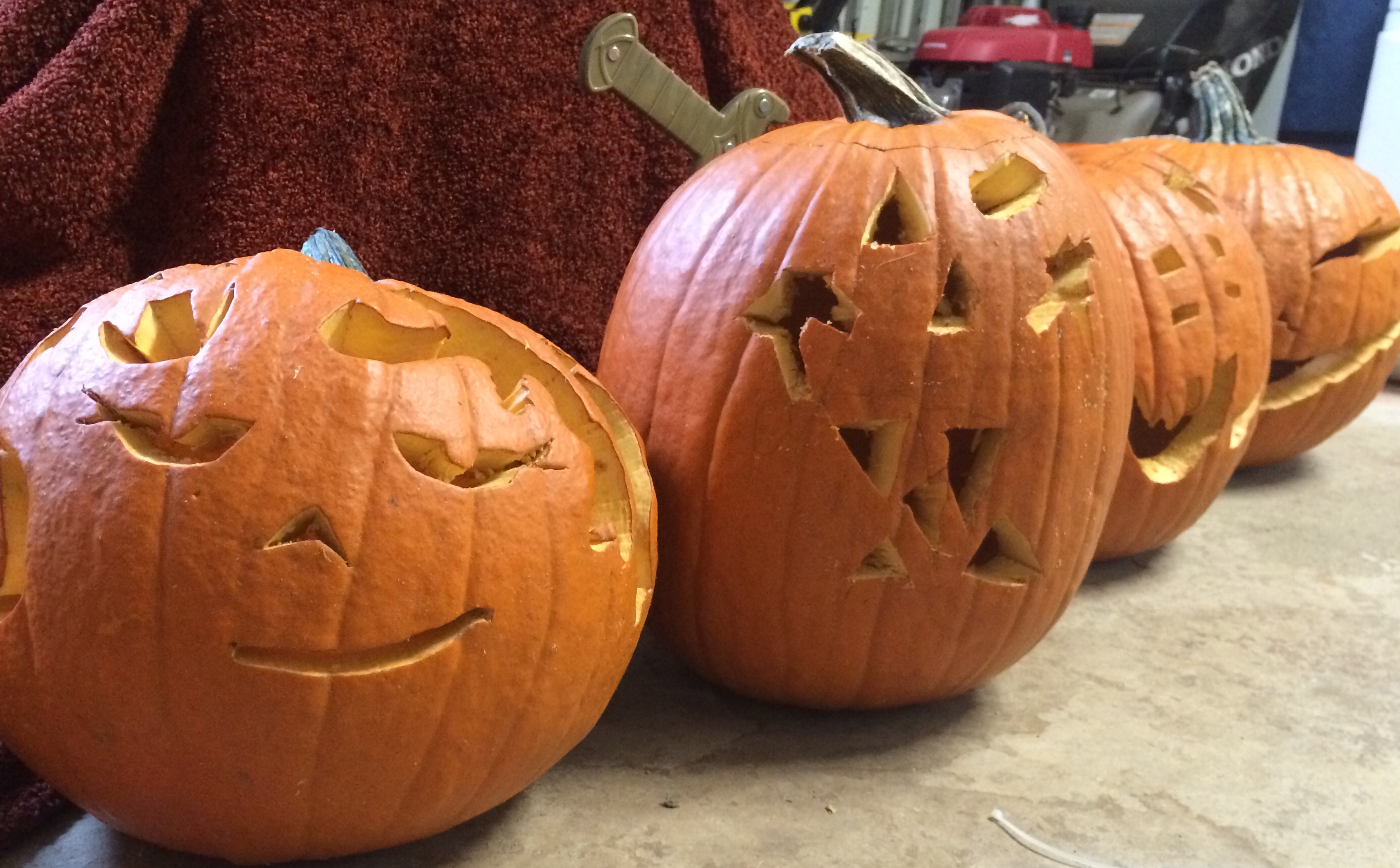
Jack o lantern

Easter has its eggs.

Christmas has its sugar cookies.

Halloween has its Jack-O-Lanterns.

All are perishable materials that have potential to go rotten all too quickly. They are holiday treasures that wild rodents would feast on if given the chance. They are mere decorations that take effort and planning to execute, only to be tossed out once they start to smell.

I love it.

I love how fleeting these three are, and that the opportunity to partake in these traditions comes and goes so quickly. Even if you’re a planner, you cannot do these six months ahead of time. If you are a procrastinator you absolutely have a hard and fast deadline for completion. Since I can be both simultaneously, this tiny window of opportunity keeps me in the moment.

The knowledge that these creations will be eaten or thrown away so soon also has the power (however temporary) to stop me from being a perfectionist. I am considerably less worried about making mistakes when I know my artwork isn’t meant to last. I take chances. I take risks. I have fun. I make mistakes and it isn’t the end of the world. The rest of the year crafting -essays, costumes, turkey dinners- can bring out the worst in me. I become a wreck when I miss a detail or when an innocent bystander has gently pointed out a flaw. There have been tears and wailing and gnashing of teeth. The kids have picked up on it. By nature and nurture they are doomed to be perfectionists, too. At least these few guaranteed times a year I can model something different for them.

Don’t get me wrong, I do put a lot of effort into these creations. I spend a lot of time meticulously layering colors and tape to make an Easter egg that looks like a strawberry. For a skunk-inspired Jack-O-Lantern, I made the kids model their best “I smell something nasty” faces. I take time and I put thought into it, but if frosting smudges together, or dye isn’t quite the right shade, or if an idea I thought was clever doesn’t pan out (one year I tried to make a pumpkin who was horrified that his brother pumpkin had been made into a pie and had to explain it to everyone) it doesn’t matter. It will not stand to haunt me for the rest of my days, and it isn’t the only time I’ll ever be allowed to try something new. There is always next year.

And for once (or technically, at least three times a year) I am so not worried about how my stuff is turning out that I can really enjoy what the boys and my husband are making. I am not just watching them make art as a spectator or a member of their audience. I am not trying to carve out quiet time away from them so I can finally concentrate on what I’m doing. We are making things together as a family. The best part, we’re having fun

Sick Days

medicine

The weather changed. The air got colder, rain fell for days. Each night this week a little hand would reach out in the dark to find me. My little guys would discover that I was still there sleeping right next to them, and feel comforted enough to know that they could try to fall asleep. I would know, as soon as they did, if their barking cough turned frightening; they wouldn’t have to try to call for me with no breath left.

We kept the window open a crack, a towel sitting right up against the threshold to catch rainwater before it flooded the inside of the house as it had flooded the street. The cool damp air helped us all breathe better.

It was just the three of us for days. Both boys missed a whole week of school. My husband had gotten on a plane for work on Monday. Between the rain and our colds we stayed home doing just the minimum to get by. Watching movies. Taking medicine. Eating food. Sleeping. Cuddling. It was as if we had stepped back in time, when I was a stay-at-home mom with two small children too small for school.

For this one week we didn’t rush anything, not waking or dressing or eating or thinking or deciding or cleaning or bathing or bedtime kisses. When homework and playdates and PTA folders disappeared, other things reappeared. Well-loved toys that had languished in the back of cabinets now spilled out all over the living room floor, useful again. Movies that we had outgrown, at the oh-so-mature ages of five and seven and thirty-five, got new viewings-with popcorn when our scratchy throats could manage it. I got to go back in time, to when coloring with my child was part of my job description, and napping with them was an important part of our daily routine.

When they were so small and helpless before, the isolation of these sorts of days had felt stifling and dangerous. The responsibility for their health and safety weighed so heavily on my every move, and the length of the hours taxed my soul.

Now that these days are a pause from normal life, rather than normal life itself, I am able to see the gifts those long sequestered days had given them and given me.

I know them better than I know almost anyone else on earth.

We had time together to just be, before clocks and schedules ruled our days.

They know that they only need to reach their hands out a little ways for help, and I’ll be there.

Seeing Something of Myself in a “Boy” Disney Movie

Dusty

Most of my screen time is spent watching shows and movies meant for kids. I am well-versed in the Phineas and Ferb universe. I have strong opinions about there being only one girl puppy in Paw Patrol. I can tell you how the man in the yellow hat exhibits extraordinary patience in Curious George, and that in a fit of frustration with my toddler I wished I could be more like him. I can quote The Lorax, Rio, Despicable Me, Cars and Frozen without trying. I will shut down viewing of any show I think is just rubbish, but I try to see what good there may be. So, when I went to go see Planes: Fire and Rescue in the movie theater, I was glad there was enough I could appreciate.

The protagonist crop-duster, Dusty Crophopper, spent the first Planes movie learning how to believe in himself and become a famous and successful aerial racer. He accomplishes his dream, and presumably will spend the rest of his life as a racer with greater and greater success. However, at the very beginning of the second movie Dusty has discovered that his gearbox is close to complete failure. It cannot be replaced or repaired. This sudden disability will prevent him from ever racing at competitive speeds again.

I didn’t expect to see that.

Dusty, reeling from being told he has limitations he needs to accept, defies medical advice and ends up seriously injuring himself. He keeps holding out hope that someone will be able to fix his gearbox, or find a new one, only to have his hopes dashed again and again. When he decides that he will go through training to become his town’s second certified fire fighter, he is stifled by his new limitations again and cannot keep himself from being distracted by his disability. Trying to find a new purpose in his life, adjusting his expectations of what his life will be and finding he might not be able to do this new job adequately, either, is overwhelming.

I don’t ever remember seeing a kids’ movie or show that explored what a person coping with a new diagnosis or medical problem might be feeling, or the mistakes they might make.

I have gone through nearly all of the emotions that Dusty has gone through, since being diagnosed with fibromyalgia. I have, in the past, decided to ignore medical advice and have pretended I was okay only to crash and burn. I have held out hope that maybe I actually had some other illness that could be somehow “fixed” or that there would be some miracle cure that would make me feel normal again. I’ve been unsure if I would ever be well enough to teach again. When I set my sights lower, thinking perhaps I could be a teacher’s aide, I felt unsure if I would be capable enough even for that. My boys have seen me go through it, though they wouldn’t be able to articulate it. Now they have a character and a movie I can refer back to when I need them to understand where I am coming from.

By the end of the movie, Dusty does get a custom-built, better-than-before gearbox. He is able, then, to fight epic fires and race, doing both jobs very successfully. I was a little disappointed that the writers didn’t trust that Dusty could still have a happy ending with a faulty gearbox. But, that they showed a character struggle with the new reality that a medical problem can bring, I was happy with that. I could probably be easily convinced to watch it again.

What is fair?

red

My oldest is complaining again, “It isn’t fair!”

Okay, I’ll bite. I ask back, “What isn’t fair?”

“You tell me ‘no’ all the time.”

“Well, of course you get told ‘no’ all the time. You ask for hundreds of things every week. If I said ‘yes’ to everything you ask for nothing else, literally nothing, would get done.”

“You never say yes.”

“Wait a minute-did we go bowling two weeks ago? Did we go fishing this week? Did we read the book you wanted to read? Did we put the Lego set together? Did we play poker? How did we do all those things, things that you wanted to do, if I never tell you ‘yes’?”

“But you never say ‘no’ to my brother.”

“That’s because he barely ever asks for ANYTHING! I say ‘yes’ to about three requests from each of you every week. Just because he only asks for three things a week and you ask for a hundred does not mean I am unfair. The percentage of time that I tell you ‘no’ is higher, but the actual number of times I say yes is exactly the same.”

His face softens and he tells me, “I guess…I guess I just feel disappointed.” His shoulders slump. I would have never argued with his younger brother this way, and I’m ashamed that I debated him until he had to admit that I was right and he was wrong. Whatever equations I’ve created in my mind to prove how fair I really am-how we spend equal measures of time, energy or money on each kid-I was totally unfair in how I responded to him. He is only seven, after all, and if he were his five-year-old brother I would have asked him gently why he felt the way he did. I wouldn’t have tried to crush him with statistics, ignoring his feelings.

But, I tell myself, they are different creatures. My oldest is the squeaky wheel, persistent about expressing his needs and not afraid to be argumentative when he is shut down. Eventually he can be persuaded by logic and resigns himself to reality. My youngest is silent about his thoughts and needs most of the time. When he finally does express himself it is a loud tantrum that he refuses to explain unless you gently, subtly try to coax a reason out of him. At least, that is how they normally operate.

I was talking to the boys the other day about how beautiful our trees have become this fall. We talked about the purple-red edged giants, the flaming orange stunners. The year before, when I drove my youngest to preschool, there was a whole street on our route that was lined with a particular type of tree. These trees had yellow-golden, tiny, tiny leaves that shook down like confetti. I asked if he remembered them. I then started going on and on about how red some bushes were by my oldest kid’s elementary school, and how they were so vivid I had to take a picture of them.

My youngest sighed then, and I asked him gently what led to that sigh. He looked resigned and sad and his brother and I were quiet enough that he actually spoke up.

“You must have liked the red leaves better.”

What?

“No, sweetie, of course not. I like all of them. Why would you think I like them better?”

“Well, you never took a picture of my trees. They must not have been good enough.”

Here was my youngest, quietly speaking up for himself, quietly presenting me with evidence I couldn’t argue with (though if it had been my oldest, I surely would have tried). Me taking the time to record one tree, and not record the other, was the same as valuing the experiences I shared with his brother more than the experiences I shared with him. This was a way of being unfair I had never thought about, never accounted for, though it instantly made sense. Sharing the things we love, making sure we don’t forget them, making and preserving those memories together is very important.

I stalked those trees for weeks, working to get a picture of them fully golden with their glittering leaves shaking down. I wanted to make it right.

I apologized to my oldest for arguing with him so much.

I am trying, very hard, to be fair.

golden trees

Wasting Peels

orange peels

I had the boys try candied orange peels last Christmas.

There was a recipe I had wanted to try for years (actual, literal years). I had to track down raw hazelnuts, white pepper, candied lemon and orange peel and candied citron. The result, a tooth-breaking concoction, is a story for another day. In the end, I had quite a large amount of orange, lemon and citron to figure out what to do with, because I will most likely not be trying that again.

I really tried to sell those leftover candied orange peels. I explained how people knew how to make candied fruits before there were knights. How the process to make these is involved, taking days of boiling and boiling again and soaking everything in a thick sugar syrup. How this was a way to preserve sweets before electricity and refrigeration. How back in time nothing was wasted, not even peels. How it used to be when you yourself took the time to plant and harvest, raise and slaughter, grind and bake all your own food.

The boys took one ginger bite each. “This is what people used to have for candy?” My oldest is grimacing, but trying politely to hide it.

“Well, yeah…”

“You know, I feel really bad for people back then, that this is all they had.  Especially if it was so hard to make,” he concludes.

“Mommy?” My youngest is trying to hand his peel back to me. “Do I have to finish this?”

I say what I always say in these cases, “No, honey, you never have to finish dessert.”

It is clear it is going to be up to me alone to eat these; no one else will be helping me do so. I cannot just throw them away, especially after all the weight and importance I put on them.  I’ve started to feel bad for the Medieval children who would have treasured these, those poor souls my own child pities not because they had horribly short life expectancies or lived in disease-ridden poverty.  He pities them for their lack of M & M s and Reese’s Cups. I vow, solemnly, to enjoy them before buying any more treats for myself.

That vow was broken almost immediately, and shamefully, by a McDonald’s apple pie. It was purchased as one of two for a dollar. The other pie was thrown out when I realized eating both secretly in my car would have cost me 500 calories. I tried to give the second one to my youngest in the backseat. He had the good sense to tell me, “I don’t really want any. You know, you don’t ever have to finish dessert, Mommy.”

If any fourteenth century kids ever time-travel and witness this, I am certain that they would shake me by the shoulders, maybe even smack me around a bit, and throw a very sorry, pitying glance at my son for having to live in the world in which he does.

Storms

image

I have fibromyalgia. That means, for me at least, that at any given moment pain or exhaustion can take over my body and steal the rest of my day. I have little to no control over what will push me over, thugh I do what I can to delay that crash. I bribe my body with exercise and sleep, vitamins and a careful diet, meditation and stress-reduction. But I have as little control over its function, ultimately, as I do over the weather. On occasion my nerve endings send pain signals from all over my body, making me believe that I have suddenly been attacked by a swarm of bees. Or that invisible spirits have started stabbing me. Or that an electrical storm has started sweeping over all my muscles, all my bones, all my skin. I sometimes jump up or yell out from the pain. When I am home it is all right. My boys and my husband know what is happening. When I am at my son’s soccer game, and the temperature drops from 68 degrees to 48 degrees in less than an hour, when a real storm rolls in and I am trying to keep my other son warm and dry and make sure my Mom and Dad watching the game are also okay, when I am trying to remember how to do simple addition to get snacks for the team, when my oldest son gets angry at me for insisting he put on his jacket and for not asking him what kind of Gatorade he wanted, when my muscles cramp up so badly I’m twisted up in pain, when my own personal storm has started shocking me everywhere I can feel, when other nice parents are trying to keep up small talk, when something is stabbing my eyes and I want to cry but I can’t, I just can’t, not in front of the whole world, not again, it is not all right. As soon as that soccer game was done, I ran our stadium chairs and my youngest child back to the car. Threw up in the parking lot. Sat in the car and cried. Hoped no one saw that. Hoped that if they did they didn’t think the worst. What the worst is, I don’t know. A sudden drop in temperature, a sudden storm destroyed that day. There was slow, gradual recovery, but I never got the rest of that time back. I thought about that day again the other night at soccer practice as black clouds rolled in across the sky, and I tried not to panic and make myself worse. This time the clouds only opened up to a drizzle and my body didn’t betray me. I thought quickly enough to stop myself from yelling to the sky, “Why? Why not this time? What did I do to deserve that last time? What did I do to deserve this now?” Instead I was able to laugh dryly for just a second. I muttered quietly to myself or God or someone, “Thank you. Thank you for letting this time not be as bad.” Though, I would still like to know why.

Lego Destruction

Legos

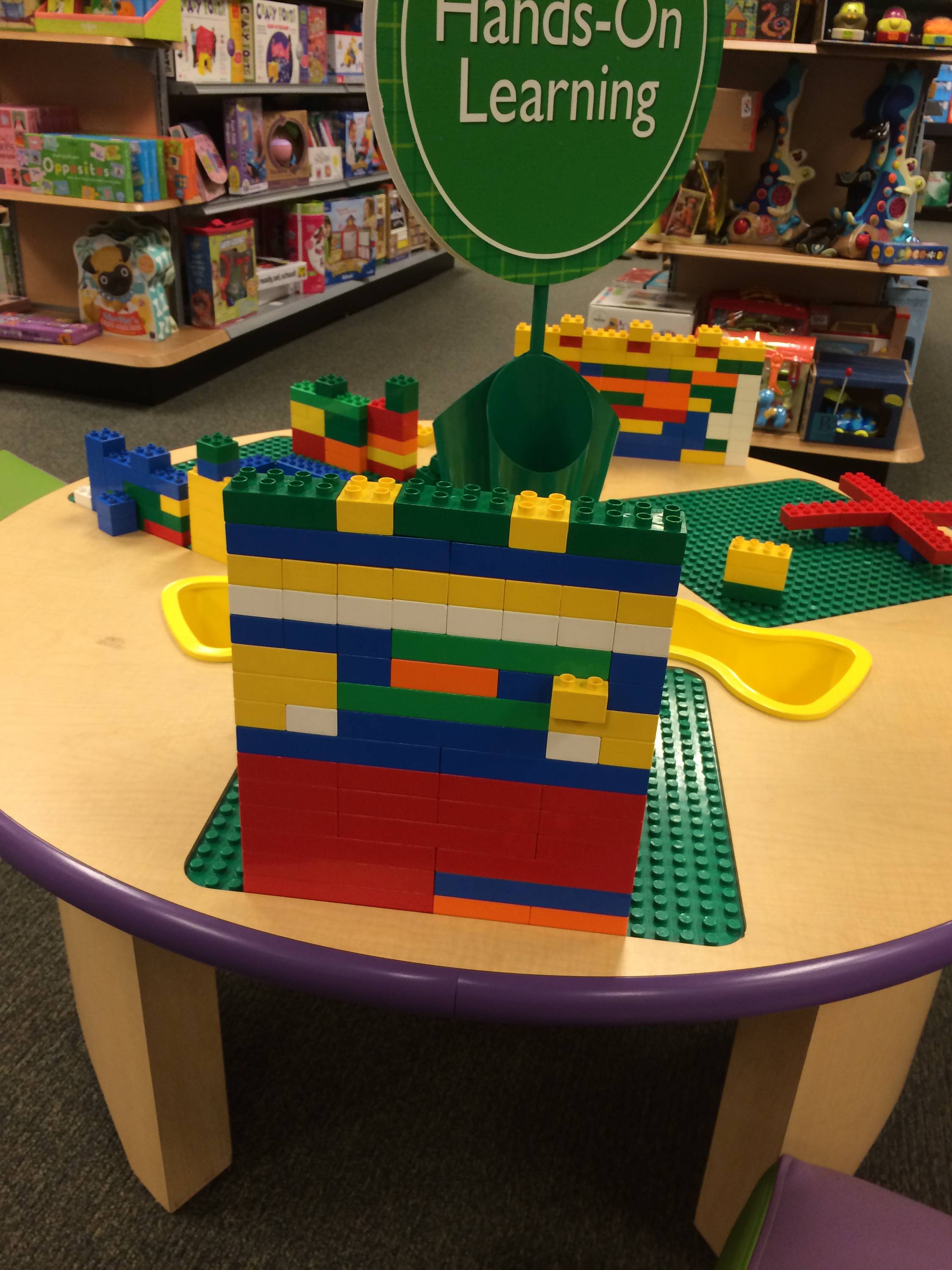
Legos can be…tricky.  Like a blank page and all the words in the English language, a bucket full of pieces seems to offer infinite possibilities for creation.  When you get into constructing your vision you start to see all the problems: how two pieces won’t actually fit, or how it doesn’t look how you imagined it or how it could fall apart at any second.  It can be difficult when it looks easy.

My youngest had been working very hard and very frantically at building a spaceship with Legos. Because he wanted it to be something no one had ever dreamed up before, his older brother and I couldn’t help with its architecture. We couldn’t really point out where a wing could be reinforced or where landing gear could sit without being knocked off the first time it “landed”. He had a vision we couldn’t see yet.

I had been casually calling out to the living room, “Hey buddy, dinner’s almost ready,” while getting out dishes and turning off timers. As I brought one thing after another to the kitchen table, I could glimpse him with the Legos on the couch. I could sense him getting angrier and angrier, and I just assumed he was mad at me for interrupting his game. A little annoyed that he was getting annoyed, I tried one last time to get him to the table to eat. “Hey, come on now, you need to come to the table. I gave you fair warning that it was time.” At that he let out an anguished cry and threw his whole spaceship to the ground. It broke, scattering hard-edged colors in every direction.

“What on earth was that?” This is not a destructive kid. Except for one strange week near his fourth birthday, he has never thrown or broken anything.

He screamed back at me, “I couldn’t get it right!” With his eyes scrunched tight and hot tears coming down, I could see him as an adult throwing a thick manuscript into a fire.  A bitter, worn, angry old man willing to call his work garbage because it wasn’t what he wanted it to be.  Destroying every word, every sentence, every page all at once.

When he looked down at what had really become of his spaceship, he saw that not one part could be salvaged.  The horror of what he had done overwhelmed him.  I’ve never seen him sob so hard.

I held him for a while but I couldn’t really calm him down.  I tried to convince him that maybe using the bathroom, eating, resting would help.  Eventually he sat in his own chair in the kitchen, quiet. Even more quietly, he slid out of his chair and into the living room.  He sat on the rug and for the next twenty minutes he rebuilt his spaceship. When he was done he came back to the table and ate his now-cold dinner without a word.  His older brother and I ate silently, watching it unfold.

I’ve heard experts say please, please let your children fail when they are still children. Let them lose a game, mess up a friendship, fall off the playground without intervening so much.  Their lives are going to be filled with problems and they need practice solving them when the stakes aren’t so high. Let them work through difficulty instead of rescuing them. This time, even if I had wanted to, I couldn’t rescue him from his creative frustration and I certainly wasn’t able to comfort him. I got to watch him decide what to do about that demon that told him his creation wasn’t good enough, wasn’t right. He wept over the aftermath of destroying it. He decided on his own that it was imperative to try again.

At bedtime, I told him I was proud of him. One day it might be an entire manuscript that he wants to hurl violently away.  And maybe some memory of this, quiet and still, will make him pause before he can do it.