But, Only Hipsters Have Triangle Tattoos

Maslow's

I am certainly not a hipster.

I also do not have any tattoos.

Yet.

But, lately, the tattoo I have been planning out in my head is a simple striped triangle. A representation of Maslow’s Hierarchy of Needs.

My teacher friends might remember this concept from back in developmental psychology courses. The basic idea is that we are all motivated by irreducible needs, and that once we meet our basic needs we are able to climb higher to try to achieve more lofty ones. The concept is framed as a pyramid.

The base layer of the pyramid contains our basic biological and physiological needs – our need for air, water, food, shelter, sleep. These needs have to be met for us to move on to the next level.

The next level up contains our need for safety – protection from danger (whether that danger is a poisonous snake, a tornado, or a criminal), law and order, stability.

The level after that contains our need for love and belonging – friendship, affection, intimacy, romantic love, family.

The level after that contains our need for esteem – self-esteem, mastery, achievement, independence.

The level after that contains our cognitive needs – stretching our brains, learning, finding meaning.

The level after that contains our aesthetic needs – appreciation for, the search for and the creation of beauty.

The level after that is our need for self-actualization – becoming the highest version of yourself you are capable of becoming.

The last level is the need for transcendence – overcoming the limitations of human needs and human forms. It is complete spiritual fulfillment.

This seems like an orderly way to explain the motivation of human beings, that once the bottom rung of needs are met then we can seamlessly turn our attention to the next level and so on and so forth. When I turn back to this model in times of chaos, it provides me with a way to get my life back under control. When the pain or fatigue or depression that can be associated with fibromyalgia begin to severely limit my ability to function, I go back to the pyramid. I go back to the basics and make sure I take care of each level I can in order. It helps.

It also gives me an organizing principle for deciding what is most important for my children, for my family. Food, water, sleep, shelter first. We are very lucky that the first needs are securely taken care of. Safety is always next. This is such a part of our life that I can yell out to them at any given point, “What is my number one job as your mommy?” and they will yell back, “To keep us safe!” If there is a question of priorities, those win.

It helps stave off bad behavior, usually. Most tantrums come about when basic necessities are off – the boys haven’t eaten in a while, they stayed up too late, they feel sick and need rest and medicine. My youngest had a tantrum this morning because his need for safety was not being met to his liking. He thought he would have to get a shot at his doctor’s appointment when he did not. Once he felt safe (all of his vaccinations are up to date and he needed no boosters) the rest of the day fell into place.

This helps me prioritize what charities we support with the little extra we have. Charities that feed and clothe and shelter people get our attention first. Charities that keep people feeling safe and loved next. Charities that teach after that.  If you can do all of those at once, even better.

I taught in a public school and can tell you first hand how difficult it is for a child to learn if his basic needs, his need for safety or his need for belonging are not being met. Any programs that provide breakfast and a safe environment should be protected. Any wonderful people who can make a student feel like he or she is meant to be right there with them, who can make a student feel safe and accepted, should be truly appreciated. Then mastery and learning can happen. Not before. The pyramid as an organizing principle makes sense again.

But, and this is very, very important, we as humans are not always orderly. A shock, I know. We sacrifice having basic needs met to hit those higher levels. There are examples everywhere. We lose sleep night after night after night going for a promotion. We eat a plate of fries when the problem is not that we are hungry, but that we are lonely. We let obsessions with mastering a level on a video game run over our loved ones. We skip meals to fit into a gorgeous dress because we want above all else to be beautiful. We often choose to meet needs out of order.

And, if under extreme circumstances there is little to no possibility of having our basic needs met, we strive to fulfill any of the needs we have any chance of meeting. Gang members may find their need for belonging is stronger than their need for safety. During unspeakable horrors like the Holocaust, people have turned to learning and appreciation of beauty as the only needs they could fulfill or help others fulfill. Countless people have had to look at transcendence as the only need they could hope to meet in the midst of war or starvation or natural disaster. Our needs are irreducible.

I want a visual reminder that every person alive on earth has real needs.   A reminder that my needs are real, that the needs of other people are real, that meeting those needs is imperative. I want a reminder that this organization of those needs has often helped me and others, and I feel anchored by it.

I want a simple, striped, triangle tattoo.

I also would really, really like it if this tattoo didn’t also scream to the world, “I wish I were a twenty-something hipster who loves the clean lines of geometric shapes” when I am really a thirty-something conventional mom and former educator who actually prefers photo-realistic tattoos of things like flowers and insects and birds.

But,

That isn’t a real need.

Inspiration and Execution

Sunday Morning

A conversation with children at 7:00 AM. It is a chilly winter morning, and two young boys ages 8 and 5 beginning interrogating their harried mother.

Youngest: Don’t we have any dreidels?

Mother: Well, no. We don’t.

Youngest (cries as if heart is broken)

Mother: What on earth???

Youngest: I want to collect dreidels.

Mother: I…uh…huh?

Oldest: So I just made up this drum set. How long did Fleetwood Mac practice before they were rock stars?

Mother: I…huh…what? Do you mean Mick Fleetwood? I don’t know, what did they say on the show?

Youngest: (still crying)

Mother: (switching attention rapidly between one child and the next) Ok, kiddo, we just don’t have dreidels. It’s not the end of the world, sweetie, really it’s not.

Oldest: Wanna hear my new song I made up? Can I take drumming lessons? How long do you need to take drumming lessons?

Mother: I…uh…huh…what?

I have to be careful what sorts of TV shows I watch with my kids. It is not about violence, or sex, or even foul language. The above transcript comes from a morning where my boys watched a recorded episode of CBS Sunday Morning with me. This episode featured interviews with Mick Fleetwood and an older gentleman who owns the world’s largest collection of dreidels. Other episodes convinced the boys that they wanted to sculpt huge sandstone caves, create street art, start a bakery, and become comic book authors. Some days I am not up for how excited the boys are.

Mother: (just too tired to think straight) That is IT! We cannot do everything! These people, the people on these shows spend their whole lifetimes doing what they do-we CANNOT replicate what they do in the space of a morning. We are not going to pout about it either. Just, everybody CHILL OUT!

But, most days, I am able to appreciate the way a segment on a show can ignite their imaginations. And I am a little jealous. I have found them designing huge pumpkin sculptures (with trick-or-treat buckets and stuffed animals) after watching Halloween Wars. They’ve made River Monsters out of Legos and blocks and boats out of kitchen chairs. We made a turkey-shaped sugar cookie at Christmas because a contestant had on Holiday Baking Championship. Every room of the first floor was commandeered recently for a live-action game of Boom Beach that went on for two hours.

Come to think of it, it really isn’t just TV shows. Sometimes it’s video games, apps, zoos, restaurants, songs, books. Everything can become a game, or a new dream to pursue, or a book they need to write.

One of my favorite days was right after we had been to The Museum of Science and Industry. We had seen the recovered submarine U-505 there. The next day they decided to play Battleship, which seemed reasonable as we’ve had that board game forever. When I came into the playroom, they had set up a fortress wall that divided the whole room in half. Homemade boats studded the sea of carpet. They threw stuffed animals at each other to sink the other person’s makeshift navy. And once a boat was sunk (they assured me no one on board was hurt) the boats were hauled away to be “museumed”.

I miss childhood and the way you can run off with an idea as soon as it pops into your brain. I get tired of having to postpone a project for dirty dishes, e-mails to the boys’ teachers and calls to refill prescriptions. I’m tired of waiting weeks and weeks between inspiration and execution. I’m frustrated with rainy days and budgets and tax appointments and laundry, but I suppose most adults are. I try not to let my jealousy peek out too often, because I am absolutely glad that this is something the boys can have, that I can give them now. As adults, as far as I can tell from myself and most other adults I know, they’ll still get a million ideas but they will have less time to actually do anything with them.

This post, alone, has been a nebulous idea that has floated around in my brain for at least a year and a half. And I have had a stolen hour Monday and a half hour this morning to get anything that made any sense written down. And that was only available because the boys saw a YouTube clip of a Hot Wheels track in a bathtub that they wanted, on Monday night, to try for themselves.

Pokemon Cards and Competition

Pokemon

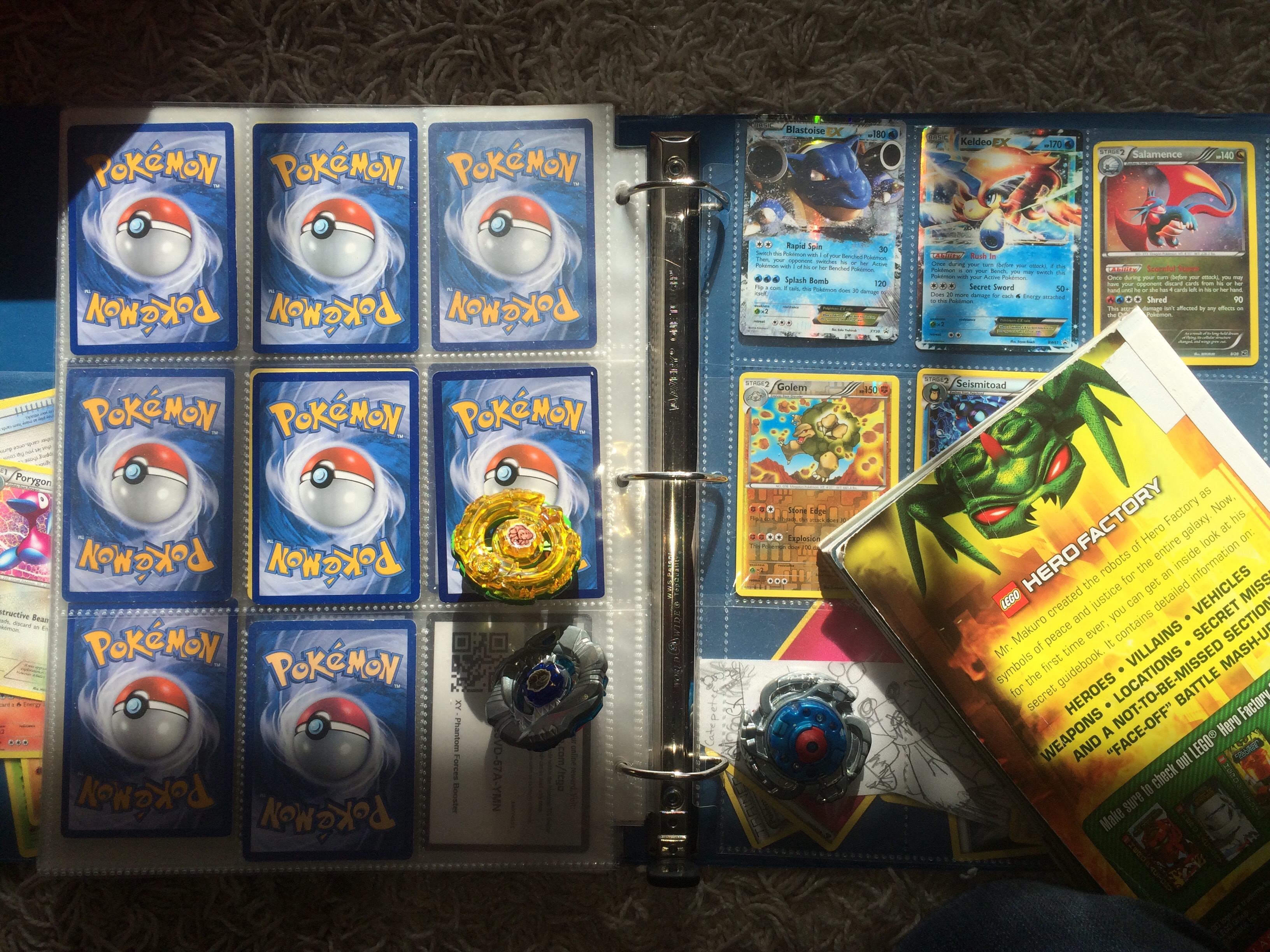
The games and toys that my two boys play with most often all have one thing in common. They all involve a huge cast of characters who must do battle in one form or another. Whether in video games like Skylanders or Super Smash Brothers, or as tangible action figures from Lego’s Hero Factory, or as spinning tops called Bey Blades or in their huge binders full of Pokémon cards, my children know each and every one of these competitors and how they perform in competition.

Do you by any chance know who Pop Fizz, Ninjini and Eye-Brawl are? How about Preston Stormer, Ogrum or Von Nebula? Charizard, Pidgeot or Gangar? I kind of know who they are, but my eight-year-old and my five-year-old could tell you exactly how they attack, who they attack, how much health and stamina they have and what are their main weaknesses. And there are hundreds more that they can describe in such detail. When they give me lists for Christmas or their birthdays, it becomes a long string of gibberish to my ears as they rattle off the characters they still need. I nod as if I understand. A lot. The once-in-a-blue-moon occasion that I remember some of these details leads them to believe I really am paying attention. Sometimes, sort of.

I didn’t play these games as a girl. I tried to decide if that was because I was a girl. I had traditionally feminine, gendered toys I loved: baby dolls, dress up clothes and a pretend kitchen. But I also had many that were not specifically “just” for girls: balls, bats, musical instruments, puppets, paints, roller skates, bikes, a microscope and even Pipeworks (a set of PVC pipes you joined together to make forts). I look at the playtime choices I made among the choices that were given, and I see that I practically never, ever chose something competitive. There was almost never a winner or a loser, no one was ever glorious in victory or saddened by defeat. That wasn’t a part of my play, or of my imaginative world. I anticipated my baby doll’s needs, I squished play-doh, I made up dance recitals in the living room and pretended to be trapped on a desert island in a version of Survivorman meets playing house. I looked at leaves pressed between slides. I made up restaurant menus. Fighting, battling and competition weren’t there.

Why weren’t they?

Competition, and the desire to win at all costs, was considered a scourge as I grew up. Perhaps it was reactionary to the 80’s corporate culture, and a byproduct of the 90’s focus on diversity and inclusiveness. Maybe I had the message reinforced for me in church and school and home that caretaking, cooperation and empathy were far more valuable traits to cultivate. And maybe those traits were emphasized more strongly because I was a girl. And maybe, because I definitely wanted to be seen as a girl, I took to it. Or maybe those qualities were what I was naturally good at, anyways.

I look with curiosity at my children’s obsession with competition games. I am trying to parse out whether there is a problem with this play, because it looks so different with my own. The bottom line: I don’t think there is.

There are gendered expectations put on boys that they will have to engage in competitive activities. There are biologists who are fairly certain that competitive activities go hand in hand with testosterone. There are plenty of men and women I know who (gasp!) actually enjoy competition through sports and games and career-building. While I’m sure I could cite many examples of competitive spirit that went far, far over the line, I believe that the problem arises when it is taken to an extreme.

So, my boys are gearing up to be competitive creatures and to enjoy it. What lessons about competition are my kids taking away from Pokémon cards, specifically?

They are exposed to the idea that every competitor has unique skill sets. No one character is identical or has identical attacks. The diversity of successful competitors, from the cute and cuddly Pikachu to the enormous Mammalswine, gives credence to the idea that there is not just one successful archetype. Success, even in a narrowly defined arena, can look very different.

They are also familiar with the concept that every player has specific weaknesses. These weaknesses may cause them to take on more damage in a fight, if they are attacked in their vulnerabilities. However, everyone has a weakness. There is incentive to carefully choose whether to exploit that weakness for personal gain or not. The boys know that they could be exploited themselves. They know, too, that their weakness is normal and not necessarily of harbinger of defeat.

They watch DVDs of Pokémon exploits where battles are ethically constrained. The Pokémon practice their skills to improve. The trainers must acknowledge the feelings, health and well-being of their fighting Pokémon. The Pokémon themselves enjoy pushing themselves to learn a new move, but know when to rest. Wins and losses are accepted with grace.

And this is similar in all these competitive games they play: the diversity of skills and weaknesses, the need to rest and recover between matches, the impulse to improve, the good sportsmanship of winning or losing with integrity. In a world where (hopefully) healthy competition will strongly shape the lives of my two boys, I am happy they have found fun ways to learn how to navigate that world

Vanity Mirror

Vanity Mirror

There once was a boy who had a crush on me, in 1995 or 1996, who said I looked like Jennifer Aniston. It was right around the time Ross and Rachel got together, and it was sweet and flattering and totally delusional. I have the same color eyes as Jennifer. I had her famous hair cut, and by nature my hair had the right color to it. I let my sixteen-year-old self be complimented, let myself be compared to a star and feel puffed up for a bit. I knew I would have been happier to be thought of as attractive on my own terms, but it was better than being heckled for looking mannish in the oversized t-shirts and flannel I had chosen in 1994 or 1995. Once in a while I would watch Friends and Rachel might make a face I recognized as my own, usually when she pouted or pined away or tripped up, when her face was scrunched or sad or embarrassed.

There was a drama teacher in 1996 or 1997 who was about to walk past me during a rehearsal for a musical. I was sitting, reading as I always did. My “Rachel” layers had mostly grown out and my fear that I would be taken for a boy had as well. I was wearing a larger t-shirt, biting on my nails as I concentrated on my book. He paused in front of me and said, “I have noticed something about you. You aren’t vain. The good actresses aren’t. They can’t be,” and he walked on. And I let my seventeen-year-old self be complimented and compared to a star. And some vanity crept back in with a compliment about its absence. And I let myself feel puffed up for a bit.

Sometime in 2014 or 2015, a movie named Cake was released starring Jennifer Aniston. Much has been made of how she has physically transformed for the role. She goes without makeup, her hair is greasy, her clothes dowdy, her visage twisted. In it her character is unpleasant, spiritually somewhat ugly and in constant physical pain. Or so I have read. Some people are applauding the way she abandoned her clean-cut good looks for the role, that it is a credit to her acting talent and craft. Some people aren’t as glowing in the reviews of her acting skills, but still credit her bravery in allowing her image to alter. Good actresses cannot be vain. The worst of the gossip rags exclaim how glad they are that she shows up on the red carpet as her old attractive self.

I have not seen the movie. I have seen stills from the set of the movie. I still look like Jennifer Aniston when her face is scrunched and sad and embarrassed. I still look like Jennifer Aniston, but now only when she is greasy, and dowdy and acting as if she is a woman with a chronic pain condition. The difference now is that I am a woman with a chronic pain condition, who on some days cannot help but leave the house when I am still in horrible sweatpants, matted hair and bare face. When I cannot help but grimace and cry instead of smiling politely.

Seeing Jennifer Aniston this way, this mirror of what I sometimes look like now, was ego-crushing. In this movie, she does look awful. Purposefully so, but still. So I can look pretty awful, too. Even if I don’t witness it myself, because many days I don’t even look in a real mirror, it is still there. I cried some. I growled that Jennifer Aniston wasn’t really sick, just pretending, but I was. So I might always look this way. Obsessively swiping through images, searching out all the horrible things said about Aniston’s appearance, cataloguing the disparaging adjectives, showing the pictures to my husband against his will: the tailspin I let this put me in was ugly.

Despite the compliment from my teacher, I absolutely can be vain. I don’t think I can get around that. I can give myself a break and say, “There will be some days I feel like shit. And sometimes that will show. And that is okay.”

And… despite being flattered by a teenaged boy when I was a teenaged girl, I can still decide that he was wrong, and that I look like no one but me. Mercifully I have the power to release myself from any comparisons, good or bad.

Punishment

workout

I would like to add an author’s note here.  This post was written before the controversy around 19 Kids and Counting, before we knew that Josh Duggar had victimized his sisters and other young girls, before his hypocrisy in condemning homosexual couples paired with him soliciting extramarital affairs.  I could take this post down, but I still feel a connection to the idea that we sometimes punish ourselves with TV shows and Instagram accounts and celebrity reality shows, taunting ourselves with what we can’t have.  For the record, I did seem to think they were doing a good job raising children and am currently shaking my head realizing that all I knew was an highly edited version of their lives-not what really went on. 

I used to watch 19 Kids and Counting each afternoon when I exercised at our local rec center. And by “used to” I mean I watched it daily up until a week ago.

The Duggars kind of fascinate me.

Obviously, their life is very different from mine. Rural Arkansas and its lack of diversity is a different world from the suburbs of Chicago, and as a one-time public school teacher I don’t really agree that homeschooling is the way to go, and I generally wear pants and low-cut tops whenever I feel like it, modesty be damned. Their Christianity doesn’t resemble mine, especially when I mix it with Buddhism or scientific inquiry. Oh, and I have seventeen less children than the Duggars do.

They seem to be good parents. I understand how reality shows can be edited, but from what I can see they instruct their children with patience and love. They seem to be thoughtful about how to foster good relationships and how they instill values like kindness and respect and purpose into their offspring. I quietly cheer them on when I hear more kids or grandkids are on the way. These are people who want children, see them as a blessing and seem to know how to raise them to be decent human beings. I got to see babies and cuddle them vicariously as my own got older and older. I got to see how excited these women were to find themselves pregnant again.

I had to stop watching this show.

Watching it was a way of punishing myself, flooding myself with images of a chapter of my life that is closing. It is unlikely, very unlikely, that I will be having any more babies. Having fibromyalgia is difficult with two fairly independent children; I cannot imagine how much pain I would be in going back to newborn days when sleep deprivation goes on for months and months. And, according to some blood tests, the chance of me even becoming pregnant again is very low- as low as it would be for a woman ten or fifteen years older.

I have been intensely angry at my body, though I hadn’t realized it.

I have quietly and persistently been furious with my body for all of the things it cannot do. I am angry when I can’t play at the playground with my kids or take them to the pool, when at a fun run I am even slower than a three-year-old and a woman who is recovering from surgery, when I can’t stay up late without major consequences. I am furious at what I can’t have: the shoes I can’t wear because they jar my spine, the food I can’t eat because it makes pain run up and down my arms, the plans I have to cancel because I cannot do one more thing.

The babies I can’t have.

Not that I was planning on having more anyways.

Watching the off-the-charts fertility of the Duggars was a super subtle way of admonishing my body, reminding it of its shortcomings. That I watched it while exercising, which I don’t want to do but I have to do every day so I don’t feel even sicker, was the sneakiest way ever to be mean to myself.

So, I stopped.

It’s a small turning point, one that would be invisible to the people who see me on the elliptical machine every afternoon, but I think it’s an important one. And so far my body seems relieved that the activity I put it through every day isn’t rooted in so much anger and disappointment. It feels happier.

Seeing Something of Myself in a “Boy” Disney Movie

Dusty

Most of my screen time is spent watching shows and movies meant for kids. I am well-versed in the Phineas and Ferb universe. I have strong opinions about there being only one girl puppy in Paw Patrol. I can tell you how the man in the yellow hat exhibits extraordinary patience in Curious George, and that in a fit of frustration with my toddler I wished I could be more like him. I can quote The Lorax, Rio, Despicable Me, Cars and Frozen without trying. I will shut down viewing of any show I think is just rubbish, but I try to see what good there may be. So, when I went to go see Planes: Fire and Rescue in the movie theater, I was glad there was enough I could appreciate.

The protagonist crop-duster, Dusty Crophopper, spent the first Planes movie learning how to believe in himself and become a famous and successful aerial racer. He accomplishes his dream, and presumably will spend the rest of his life as a racer with greater and greater success. However, at the very beginning of the second movie Dusty has discovered that his gearbox is close to complete failure. It cannot be replaced or repaired. This sudden disability will prevent him from ever racing at competitive speeds again.

I didn’t expect to see that.

Dusty, reeling from being told he has limitations he needs to accept, defies medical advice and ends up seriously injuring himself. He keeps holding out hope that someone will be able to fix his gearbox, or find a new one, only to have his hopes dashed again and again. When he decides that he will go through training to become his town’s second certified fire fighter, he is stifled by his new limitations again and cannot keep himself from being distracted by his disability. Trying to find a new purpose in his life, adjusting his expectations of what his life will be and finding he might not be able to do this new job adequately, either, is overwhelming.

I don’t ever remember seeing a kids’ movie or show that explored what a person coping with a new diagnosis or medical problem might be feeling, or the mistakes they might make.

I have gone through nearly all of the emotions that Dusty has gone through, since being diagnosed with fibromyalgia. I have, in the past, decided to ignore medical advice and have pretended I was okay only to crash and burn. I have held out hope that maybe I actually had some other illness that could be somehow “fixed” or that there would be some miracle cure that would make me feel normal again. I’ve been unsure if I would ever be well enough to teach again. When I set my sights lower, thinking perhaps I could be a teacher’s aide, I felt unsure if I would be capable enough even for that. My boys have seen me go through it, though they wouldn’t be able to articulate it. Now they have a character and a movie I can refer back to when I need them to understand where I am coming from.

By the end of the movie, Dusty does get a custom-built, better-than-before gearbox. He is able, then, to fight epic fires and race, doing both jobs very successfully. I was a little disappointed that the writers didn’t trust that Dusty could still have a happy ending with a faulty gearbox. But, that they showed a character struggle with the new reality that a medical problem can bring, I was happy with that. I could probably be easily convinced to watch it again.